LiftMaster Garage Door Opener Troubleshooting: What the Flashing Lights Mean
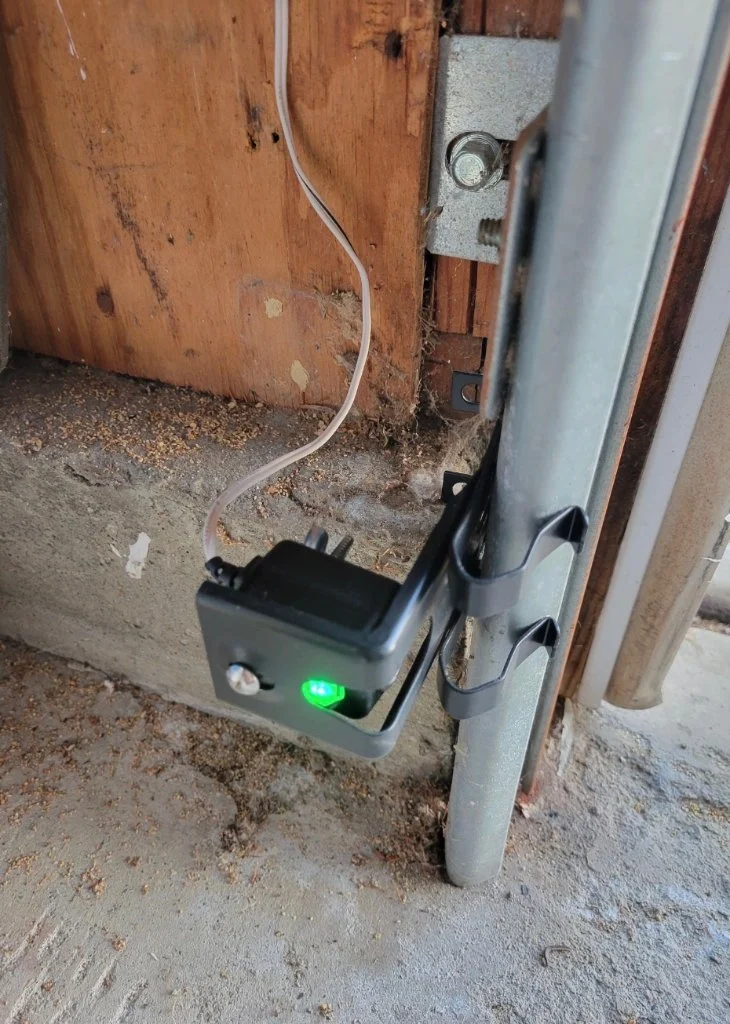
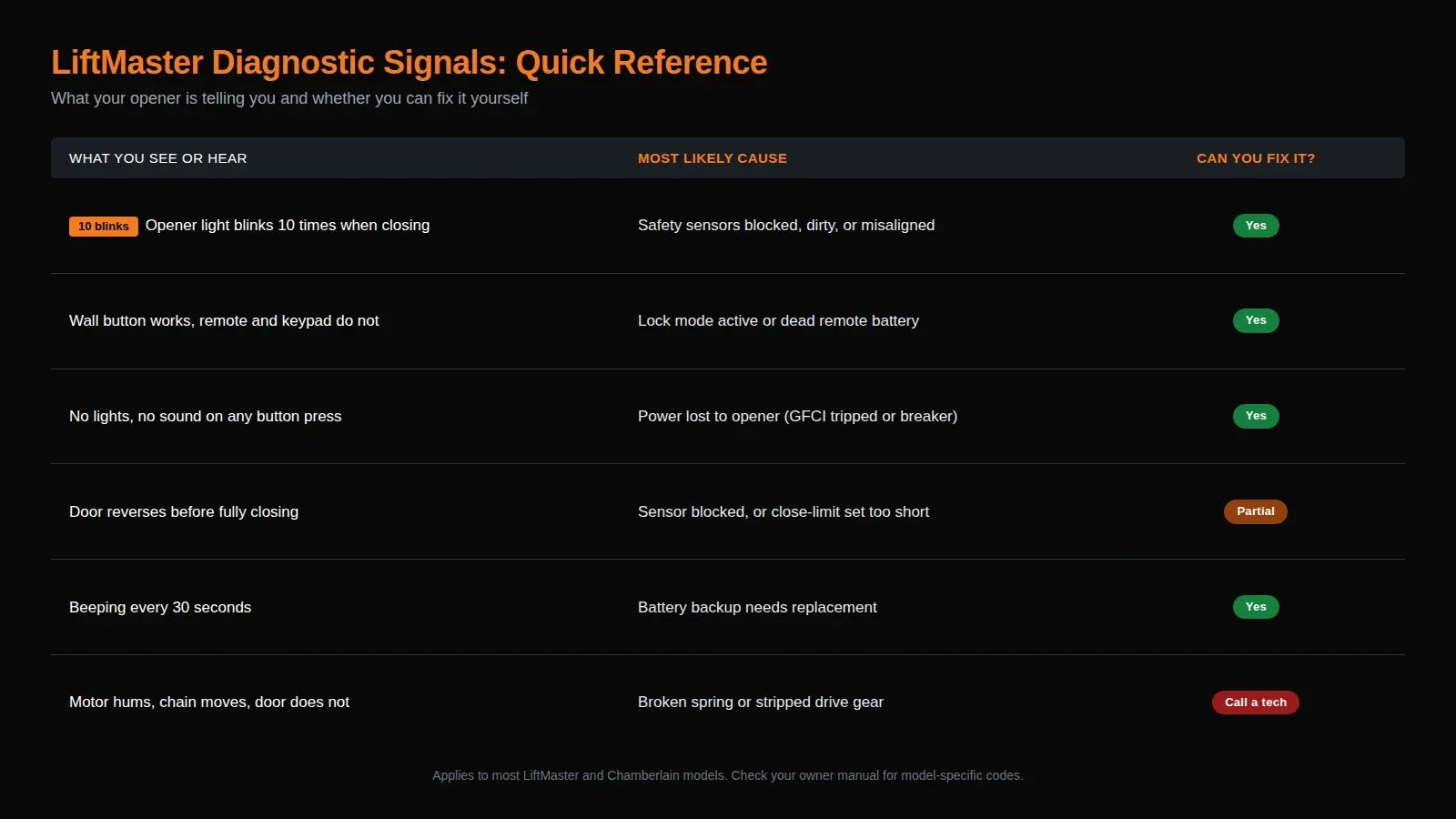
The flashing lights on a LiftMaster garage door opener are a built-in diagnostic system. When something is wrong, the opener blinks in a specific pattern on the main light or on the indicator on the wall console. Count the flashes, then match the number to the fault it signals. The most common message is ten blinks, which means the safety sensors are blocked or out of alignment. That single fault accounts for more LiftMaster service calls than anything else in the Twin Cities. The table below maps the most common signals to their causes and tells you which ones a homeowner can safely clear.
| What you see or hear | Most likely cause | Safe to try yourself? |
|---|---|---|
| Opener light blinks 10 times when closing | Safety sensors blocked, dirty, or misaligned | Yes |
| Wall button works, remote and keypad do not | Lock mode active, or dead remote battery | Yes |
| No lights, no sound when any button pressed | Power lost to opener (GFCI tripped or breaker) | Yes |
| Door reverses before fully closing | Sensor blocked, or close-limit set too short | Partial |
| Beeping every 30 seconds | Battery backup needs replacement | Yes |
| Motor hums, chain moves, door does not | Broken spring or stripped drive gear | No, call a technician |
The 10-blink code: safety sensors
When your LiftMaster opener blinks ten times as the door tries to close, it has stopped the door because one of the two safety sensors near the floor is blocked, misaligned, or not sending a clean signal. These sensors send an infrared beam across the bottom of the opening. If that beam is interrupted, the opener refuses to close. The LED on each sensor tells you which one has the problem. A steady green light on the receiving sensor means it is lined up correctly. If that light is out or blinking, the sensor is the issue.
What to check:
- Clear any object from the sensor path, including brooms, garden hoses, leaves, and boxes left near the opening
- Wipe the sensor lenses with a clean dry cloth. In Minnesota winters, frost can build up on the lenses overnight and trigger the same 10-blink fault even when nothing is physically blocking the beam
- Loosen the wing nut on any sensor that is out of alignment, adjust the sensor head until the green light goes steady, then retighten
- Trace the sensor wires from the sensor heads up to the opener unit. A wire pinched by a staple, chewed through, or pulled loose at the connector can break the circuit and cause the same flash code even when the sensor heads appear fine
If the green light goes steady and the door closes normally, the sensors were the problem. If the light stays out after checking all of the above, the sensor wiring may need replacement. See our safety sensor service for what that job involves.
Remote and keypad not responding
If the wall button still runs the opener but your remote or keypad does not, the problem is almost always one of two things.
The first is a dead battery. LiftMaster remotes take standard watch or coin-cell batteries, and they tend to run out without warning. Replace the battery and test again before doing anything else.
The second is lock mode. Many LiftMaster wall consoles have a vacation-lock button that disables every wireless device while leaving the wall button active. It is easy to press by accident. Look at your wall console for a lock symbol or a solid LED next to a lock label. Hold that button for about two seconds to toggle it off. Some older LiftMaster consoles show a lock icon on a small screen. Turn it off there.
If neither fix works, the remote may need to be reprogrammed to the opener. Our post on garage door remote not working covers that process, including how to find the learn button on most LiftMaster and Chamberlain units.
Opener has no power at all
If pressing any button produces no light, no sound, and no movement, the opener is not getting power. That rules out a broken spring, a sensor fault, or lock mode, all of which still allow the opener to power on. Start with the outlet.
Garage outlets are often on a GFCI circuit, and the tripped reset button may be on a different outlet in the garage, in the utility room, or on the exterior wall. Press reset on every GFCI outlet you can find near the garage. If that does not help, check the breaker panel for a tripped garage circuit.
Also check the power cord running from the opener to the ceiling outlet. It can work loose over time, especially in older garages with standard two-prong receptacles. Confirm the cord is fully seated in the outlet. If the outlet is dead even after resetting the GFCI and the breaker, have an electrician check the circuit before assuming the opener itself has failed.
Door reverses before it closes
A door that starts to close, then stops and reverses, is usually stopping because of one of two things: the safety sensors detected something, or the close-limit setting is telling the opener to stop before the door reaches the floor.
Check the sensors first using the steps in the 10-blink section above. If the sensor lights are steady and the beam is clear, the close-limit may need a small adjustment. The close-limit tells the opener how far down the door should travel before stopping. On most LiftMaster models, there are two knobs or screws inside a panel on the opener head, one for the up limit and one for the down limit. Turning the down-limit knob in small increments, usually about an eighth of a turn at a time, lets the door travel slightly farther. Check your model's owner manual for which direction to turn it.
If adjusting the limit does not hold, or if the door reverses very quickly after starting, the force setting may also be involved. Force settings control how hard the opener pushes before reversing. These are set at the factory and rarely need changing, but very cold weather makes a garage door stiffer and heavier, which can cause the opener to interpret normal friction as an obstruction. Our opener repair team can recalibrate limits and force settings if the adjustments do not hold through a full season.
Beeping every 30 seconds
Most LiftMaster openers sold in the last decade include a battery backup that keeps the door operating during a power outage. When that battery is running low or has failed, the opener beeps at regular intervals, typically every 30 seconds, and may show a warning light on the wall console. The fix is to replace the battery pack.
LiftMaster replacement batteries are available for each model and usually take under ten minutes to swap. Most packs are mounted on the back or side of the opener head and disconnect with a plug. If you are not sure which battery your model uses, the owner's manual lists the part number.
When a reset helps and when it does not
Unplugging a LiftMaster opener for 30 seconds and plugging it back in can clear a stuck logic board fault, particularly after a power surge. If the opener was completely unresponsive after a storm or a power flicker, a reset is worth trying before calling for service. What a reset will not fix is any fault caused by a physical problem: a sensor out of alignment, a broken spring, a failed motor, or a logic board that has actually burned out. If the opener shows the same flash code after a reset, the underlying cause is still there.
One thing to know before resetting: a full reset clears all remotes and keypads from the opener's memory. After the reset, you will need to reprogram each remote by holding the learn button on the opener and pressing the remote button within 30 seconds. See our guide on how to reprogram a garage door remote for the steps on each major LiftMaster series.
When to call a technician
Stop troubleshooting and call if you heard a loud bang from the garage, see a gap in the spring above the door, or notice the door is hanging lower on one side than the other. These are signs of a broken spring. A torsion spring holds enough stored energy to cause serious injury, and replacing one requires winding bars, training, and proper safety technique. This is not a homeowner repair. On a two-spring door, replacing both at the same time is usually the better decision since the second spring is the same age and often fails soon after.
Also call if the opener motor runs but the door does not move even with the emergency release connected, if sensor wires are visibly damaged, or if the opener is more than fifteen years old and showing more than one fault at a time. At that point, repair often costs nearly as much as a replacement, and Pronto will tell you honestly which direction makes more sense.
Pronto covers Minneapolis and all of the Twin Cities suburbs seven days a week. If the fault is in the sensors, limits, force settings, motor, or logic board, we can usually diagnose and repair it on the same visit. Call or text (612) 400-4180 for same-day availability.
LiftMaster Troubleshooting: Common Questions
What do 10 blinks on a LiftMaster garage door opener mean?
Ten blinks when the door tries to close is a safety sensor fault. The opener detected that the beam between the two sensors near the floor was interrupted, or one sensor is not reporting correctly. Check for obstructions, wipe the lenses, and look for the steady green light on the receiving sensor. In Minnesota winters, frost on the sensor lenses is a common cause of the same code.
Why does my LiftMaster wall button work but the remote does not?
The most likely cause is lock mode. Many LiftMaster wall consoles have a vacation-lock button that disables all remotes while leaving the wall button active. Find the lock symbol on the console and hold it for two seconds to turn it off. If that does not help, replace the remote battery, then try reprogramming the remote to the opener.
Will unplugging my LiftMaster opener reset it?
Yes. Unplugging the opener for about 30 seconds and plugging it back in performs a soft reset that can clear a frozen logic board after a power surge. It will not fix a physical fault like a misaligned sensor or a broken spring. It also clears all remotes and keypads from memory, so you will need to reprogram them afterward.
Why is my LiftMaster beeping every 30 seconds?
The beeping is a low-battery warning from the opener's battery backup system. The backup battery is a separate pack installed inside or on the back of the opener head. Replace it with the correct model battery listed in your owner's manual. The beeping stops once the new battery is connected and recognized.
LiftMaster Opener Still Not Working?
Call or text (612) 400-4180 for same-day service. Pronto covers Minneapolis and the Twin Cities 7 days a week.