Garage Door Opener Installation Cost in Minnesota: What to Expect
Installing a garage door opener in Minnesota typically costs $350 to $750, covering the unit and labor together. Drive type is the biggest single variable. A chain-drive changeout on a single-car door lands near the lower end of that range. A belt-drive or direct-drive unit on a two-car door, or any job that needs an electrical outlet run to the motor mount, lands near the top or above it.
The sections below break down each cost piece, explain the drive-type trade-offs that matter specifically in Minnesota, and cover the extras that catch homeowners off guard. For a broader look at what garage door work costs in the Twin Cities, see our garage door repair cost guide.
What the total price covers
A garage door opener installation bill has two main parts: the unit and the labor.
- Unit cost. Most residential openers sell in the $130 to $500 range, depending on drive type, motor size and features. A standard 1/2 HP chain-drive unit sits at the lower end. A 3/4 HP belt-drive unit with battery backup and Wi-Fi sits at the higher end.
- Labor. A standard changeout on a door that already has an outlet above it takes two to four hours. Labor alone typically runs $200 to $300 for that scope.
- Extras. An electrical outlet run by an electrician adds $100 to $150. A wireless keypad adds $30 to $60. Battery backup is sometimes sold separately for another $50 to $100.
On a straightforward one-for-one changeout with no electrical work, expect the total to land between $400 and $600 for a chain-drive unit or $475 to $700 for a belt-drive. First-time installs, which require mounting hardware and running wiring from scratch, typically add an hour or more to the labor.
Cost by drive type
Drive type affects both the unit price and how much noise the opener makes in daily use. In Minnesota, where most newer homes have attached garages and windows stay closed six months of the year, noise travels through walls and ceilings into living spaces constantly. That makes drive type a real decision, not just a line item.
| Drive Type | Typical Installed Total | Best For in Minnesota |
|---|---|---|
| Chain drive | $350 to $550 | Detached garages, budget installs |
| Belt drive | $430 to $680 | Attached garages, bedroom above or beside |
| Screw drive | $470 to $750 | Fewer moving parts, moderate noise |
| Direct drive | $500 to $900 | Quietest option, premium attached garage |
| Jackshaft (wall-mount) | $600 to $950 | Low ceiling clearance, finished garages |
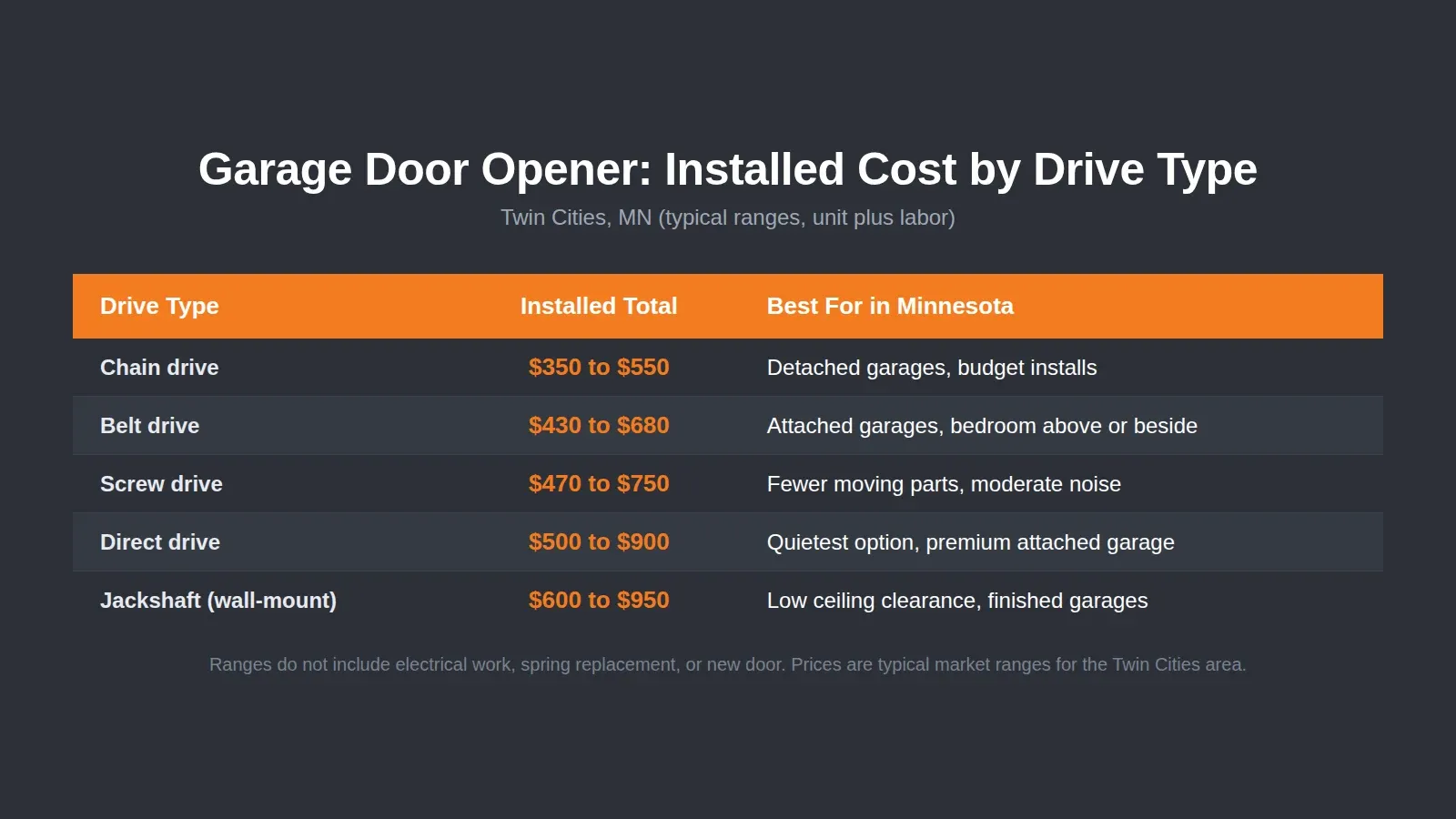
Chain-drive openers handle cold well, but the grease on the chain stiffens below zero, which makes them louder in deep winter. Belt-drive openers run on a rubber belt that does not rely on grease in the same way and stays quieter when temperatures drop. For an attached garage with a bedroom or living space above or beside it, belt drive is usually worth the extra $75 to $100. Pronto installs LiftMaster, Chamberlain and Genie; for a closer look at the Wi-Fi and camera options in the belt and direct-drive categories, see our smart garage door opener guide.
Horsepower and door weight
Motor size is the second decision after drive type. Most residential doors fall into one of three HP ratings.
- 1/2 HP. Works for a standard single-car door up to about 7 feet tall, uninsulated. It is the most common size and the least expensive unit.
- 3/4 HP. The right choice for a double-car door, an insulated door or any door that feels heavy when you lift it by hand. Insulated doors are standard on most homes built in Minnesota after 2000 and add 20 to 40 pounds over a bare steel door.
- 1 HP and above. Used for heavy wood carriage doors, oversized openings or commercial applications. If you are not sure, a technician can check the door weight before ordering a unit.
An older detached garage in Minneapolis, St. Paul or any of the inner suburbs often has a heavier wood door than the original opener was sized for. That mismatch is a common reason openers wear out faster than expected.
What raises the cost in Minnesota
Several items come up more often in the Twin Cities than in warmer markets.
- No overhead outlet. Many detached alley garages in Minneapolis, St. Paul and the older first-ring suburbs were wired with a single circuit on the wall, not an outlet above the door. Running one typically costs $100 to $150 if an electrician is on site. Without it, the installation cannot happen.
- Worn springs. A new opener does not fix tired springs, and bad springs make any opener work harder on every cycle. If the springs are near the end of their life, replacing them at the same visit is more efficient than a second call later. See our spring repair page for what that work involves.
- Battery backup. Power outages during ice storms and blizzards are a real factor in Minnesota. Many homeowners add battery backup at install time. Expect $50 to $100 for the module if it is not already included in the unit price.
- Two-car doors. A double-car door needs a wider rail and usually a stronger motor. Plan on the upper half of the drive-type range above.
- First-time install vs changeout. A one-for-one changeout uses the existing rail and outlet and takes two to four hours. A first-time install, where the rail, bracket, wiring and outlet all go in from scratch, typically takes four to six hours and costs more in labor.
Jackshaft openers: when they make sense
A jackshaft opener mounts on the wall beside the door instead of on a rail above it. That leaves the ceiling clear, which matters in garages with low clearance, built-in overhead storage or a finished ceiling. Jackshaft units are also common in newer Twin Cities homes with epoxy floor systems or utility shelving that runs the full ceiling length. The installed cost runs higher, roughly $600 to $950, but for a garage where a standard rail will not fit, it is the only workable option. Our opener installation team installs jackshaft models and can measure clearance before recommending a unit.
What to confirm before you call
A few details change the price significantly. Knowing them in advance makes the estimate more accurate and avoids surprises on the day of the job.
- Door count and size. Single-car or double-car, standard 7-foot height or taller. A two-car door usually requires a heavier motor and a wider rail.
- Outlet location. Is there a ceiling outlet above the center of the door opening? If not, ask whether the company works with an electrician or whether you need to hire one separately.
- Drive type preference. If noise matters and the garage is attached, decide between chain, belt or direct-drive before calling. The unit may need to be ordered if a specific model is not on the truck.
- Spring condition. If the springs are more than eight to ten years old, ask the technician to check them at the same visit. Replacing springs while the old opener is already off the door saves a second service call.
- Existing rail. On a changeout, the existing rail can often be reused if it is in good shape. Confirm with the technician so there are no surprises about parts.
Pronto provides a flat, upfront price before any work starts on every job across Minneapolis and the Twin Cities metro. If the job turns out to be simpler than expected, the price goes down. For anything requiring a new door alongside the opener, see our new door installation page. If you are unsure whether to repair the current opener or replace it, our guide on when replacement makes more sense than repair walks through the decision.
Garage Door Opener Installation Cost: Common Questions
How long does garage door opener installation take?
A standard one-for-one changeout on a door that already has an outlet above it takes two to four hours. A first-time install, where the rail and wiring all go in new, typically runs four to six hours. Adding an electrical outlet can add 30 to 60 minutes depending on the run distance.
Is belt drive worth the extra cost in a Minnesota garage?
For an attached garage with living space above or beside it, yes. Belt drive runs quieter than chain drive in all conditions, and the rubber belt does not rely on grease that stiffens below zero. The installed cost difference between a basic chain-drive and a comparable belt-drive unit is typically $75 to $150.
Does a new opener require new springs?
Not automatically, but springs near the end of their life will make the new opener work harder and wear faster. If the springs are old or the door feels heavy when lifted by hand, having them inspected at the same visit is worth asking about.
Can I supply my own opener and pay only for labor?
Yes. Confirm that the unit is sized for your door weight, that the rail fits the new unit, and that the manufacturer warranty allows professional install. Bring the box and the manual to the appointment.
What does the installed total include?
An installed total covers the unit, the rail, mounting hardware, the sensors, and programming the remotes. It does not include electrical work to run a new outlet, spring replacement, or a new door if one is needed.
Ready for an Upfront Opener Price?
Call (612) 400-4180 or request a free quote. Pronto gives you a flat rate before work starts, 7 days a week across the Twin Cities.