When to Replace a Garage Door Opener Instead of Repairing It
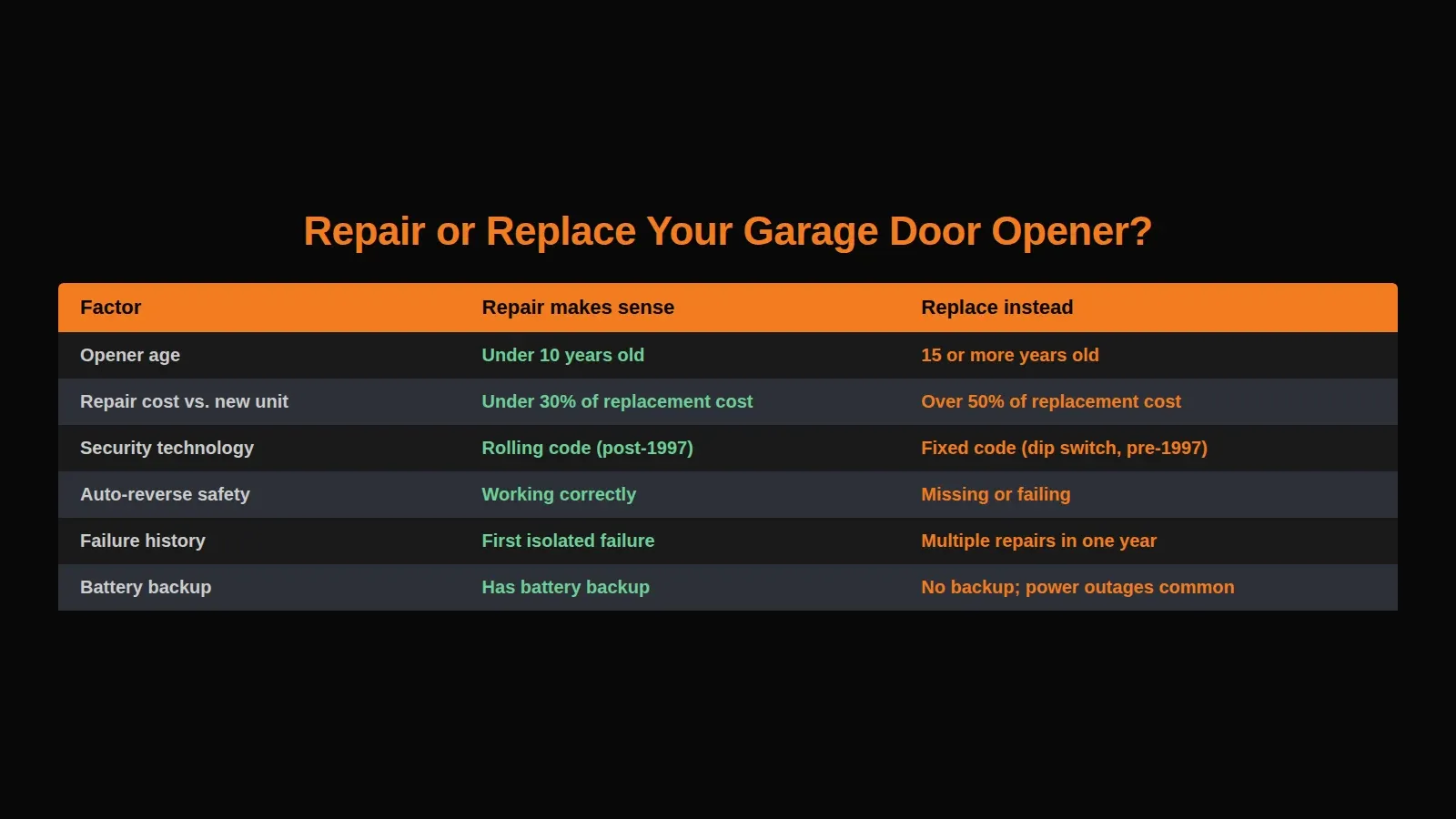
Replace the opener when it is 15 or more years old and the repair estimate is more than half the cost of a new unit, when the opener predates rolling code security, or when the auto-reverse sensor no longer works. For a younger opener with one isolated failure, repair is almost always the better call. The sections below give you the specific numbers to make that decision without guessing.
How long do garage door openers last?
Most residential openers last between 10 and 15 years with regular use. The motor, logic board, and drive mechanism all wear on roughly the same schedule, which means a unit near 15 years old may develop one failure and then show another one soon after, because the whole machine is the same age.
A household that opens and closes the garage four times a day puts around 1,500 cycles per year on the opener. By year 12, that unit has logged roughly 18,000 cycles. Chain and belt drive motors from major brands are typically rated for 10,000 to 20,000 cycles under normal load, though actual life varies by how hard the motor works.
Minnesota adds wear. On a cold January morning, the door is stiffer, old grease in the drive thickens, and the bottom seal may need extra force to pull free from a frozen slab. The motor compensates by drawing more current each time. That added load accumulates over the winters. An opener in a Minneapolis garage attached to an uninsulated single-layer door will typically reach the end of its useful life faster than the same unit in a heated space.
Repairs that are worth making
Some failures are isolated and say nothing about the rest of the opener. These are usually worth fixing:
- Remote and keypad problems. A dead battery, a keypad that has lost its programming, or a remote that needs to be relearned is a 15-minute fix that costs almost nothing and does not signal opener wear.
- Safety sensor alignment. Sensors get nudged out of position, their lenses get dirty, or a wire gets snagged. Realigning or replacing a failed sensor is inexpensive.
- Gear and sprocket replacement. On a chain drive, the plastic drive gear is the single most common mechanical failure. On an opener under 10 years old and otherwise in good condition, replacing the gear kit is usually worth it because the motor, rail, and logic board are still fine.
- Logic board replacement after a power surge. If the opener worked before a storm and now acts erratically or does nothing at all, only the board may have failed. On a unit under 10 years old, a board swap often makes sense.
- Travel and force calibration. The opener's internal settings control how far the door travels and how much force the motor allows. These drift over time, especially in cold weather, and a recalibration does not indicate any physical wear.
Signs that replacement makes more sense
Replace the opener rather than repair it when any of the following apply:
The opener is 15 or more years old. At that age, the motor, capacitor, wiring, and plastic drive components are all aging at the same time. Repairing one part often surfaces the next failure within a year. A new unit resets the clock and comes with a manufacturer warranty, quieter operation from a DC motor, and updated safety features.
The repair quote is more than half the cost of a new unit. A new opener installed in the Twin Cities typically runs $300 to $600 all in, depending on drive type and features. If a repair quote is $200 or higher on an opener that is already 12 to 15 years old, replacement is usually the better value.
The opener uses fixed-code technology. Openers built before roughly 1997 used a row of dip switches inside the remote to set a fixed numeric code. A device that can capture and replay that code is widely available online. Anyone who watches you open your garage can copy the signal. Every residential opener sold today uses rolling code technology, which generates a new encrypted code on every press. If you see a row of small switches inside the battery compartment of your remote, that is a fixed-code system, and it is a real security gap in a metro area like Minneapolis or St. Paul.
Auto-reverse is missing or failing. A federal safety standard that took effect in January 1993 requires automatic reversal if the door contacts an obstruction on the way down. Openers made before that date do not have this feature. To test yours: place a 2x4 flat on the floor in the door's path. The door should stop and reverse within an inch or two of touching the board. If it does not, stop using the opener and have a technician inspect it before letting children or pets near a closing door.
The opener has needed multiple repairs in the same year. A single gear failure is an isolated event. A gear replacement in March and a logic board problem in September on the same opener is the unit telling you it is done.
There is no battery backup. Minnesota loses power during ice storms and occasionally during severe summer weather. An opener without battery backup means the car is stuck inside or the door is stuck open when the lights go out. Every major brand now includes battery backup as standard on new units. On a 15-year-old opener that lacks it, the upgrade alone can justify replacement.
The repair-vs-replace math
A simple rule: if the repair costs less than 30% of what a new opener would run all in, repair it. If it costs more than 50%, replace it. Between 30 and 50%, let the opener's age make the call. An 8-year-old unit is worth repairing at 40% of replacement cost. A 14-year-old one is not.
On the cost side, the garage door repair cost guide covers typical Twin Cities price ranges for the individual components so you have a baseline before you get a quote.
What to look for in a replacement opener
If you do decide to replace, a few things worth knowing before you pick a unit:
- Drive type. Belt drives run noticeably quieter than chain drives, which matters if the garage shares a wall with a bedroom or a home office. Chain drives cost less and are reliable; belt drives are worth the premium on attached garages.
- Horsepower. A 1/2 HP motor handles a standard single door. A heavy double door, a solid wood door, or a carriage-style door benefits from 3/4 HP or more.
- Battery backup. Standard on most new units, but confirm before buying.
- Smart connectivity. WiFi-enabled openers from LiftMaster, Chamberlain, and Genie let you check door status and open or close from your phone. Our smart garage door opener guide covers what to expect from a connected opener and what the real-world benefits are.
One note on installation: replacing an opener is not a simple DIY project for most homeowners. Wiring the unit, aligning the rail, accounting for the spring and cable system, and running the safety tests all require specific tools and experience. Pronto handles opener repair and installation across the Twin Cities, and we will tell you honestly when a repair makes sense and when it does not. For a free estimate, call (612) 400-4180 or visit the free quote form. We serve Minneapolis, St. Paul, and the surrounding metro seven days a week, usually with same-day availability.
Garage Door Opener Replacement: Common Questions
Is it worth repairing a 20-year-old garage door opener?
In most cases, no. A 20-year-old opener is past its rated service life, almost certainly lacks rolling code security and may predate the 1993 auto-reverse standard. Even if the repair is inexpensive, you are investing in a unit that is likely to need more repairs soon and that carries real safety and security limitations. Replacement is usually the better call at that age.
What is the average lifespan of a garage door opener?
Most residential chain and belt drive openers last 10 to 15 years under typical use of three to five cycles per day. DC motor openers tend to run cooler and often reach the upper end of that range. Cold-climate garages with heavy use tend to wear openers faster than the same unit in a mild climate.
How do I know when my garage door opener is going bad?
Common signs include a motor that hums but does not move the door, grinding or straining sounds on every cycle, inconsistent behavior in cold weather that does not improve once the garage warms up, and a door that reverses unexpectedly or fails to close all the way. One or two of these on a younger opener usually means a single failing part. Several of them on an older opener usually mean the whole unit is near the end.
Can I replace just the opener unit without replacing the rail?
Sometimes. If the existing rail is compatible with the new opener and in good condition, a technician can often reuse it. Rail replacement adds time and cost to the job. When the opener is very old, the rail is usually worth replacing at the same time so the new unit does not sit on aging hardware.
Does the new opener need to match the brand of my garage door?
No. Garage door openers work with any residential door regardless of who made the door. The opener attaches to the door via the top bracket and the rail, not to any brand-specific fitting. What matters is the door's weight, height, and whether the opener has enough horsepower for the load.
Not Sure Whether to Repair or Replace?
Call (612) 400-4180 or request a free quote. Same-day service across the Twin Cities, 7 days a week.