Garage Door Opens by Itself: Why It Happens and What to Check
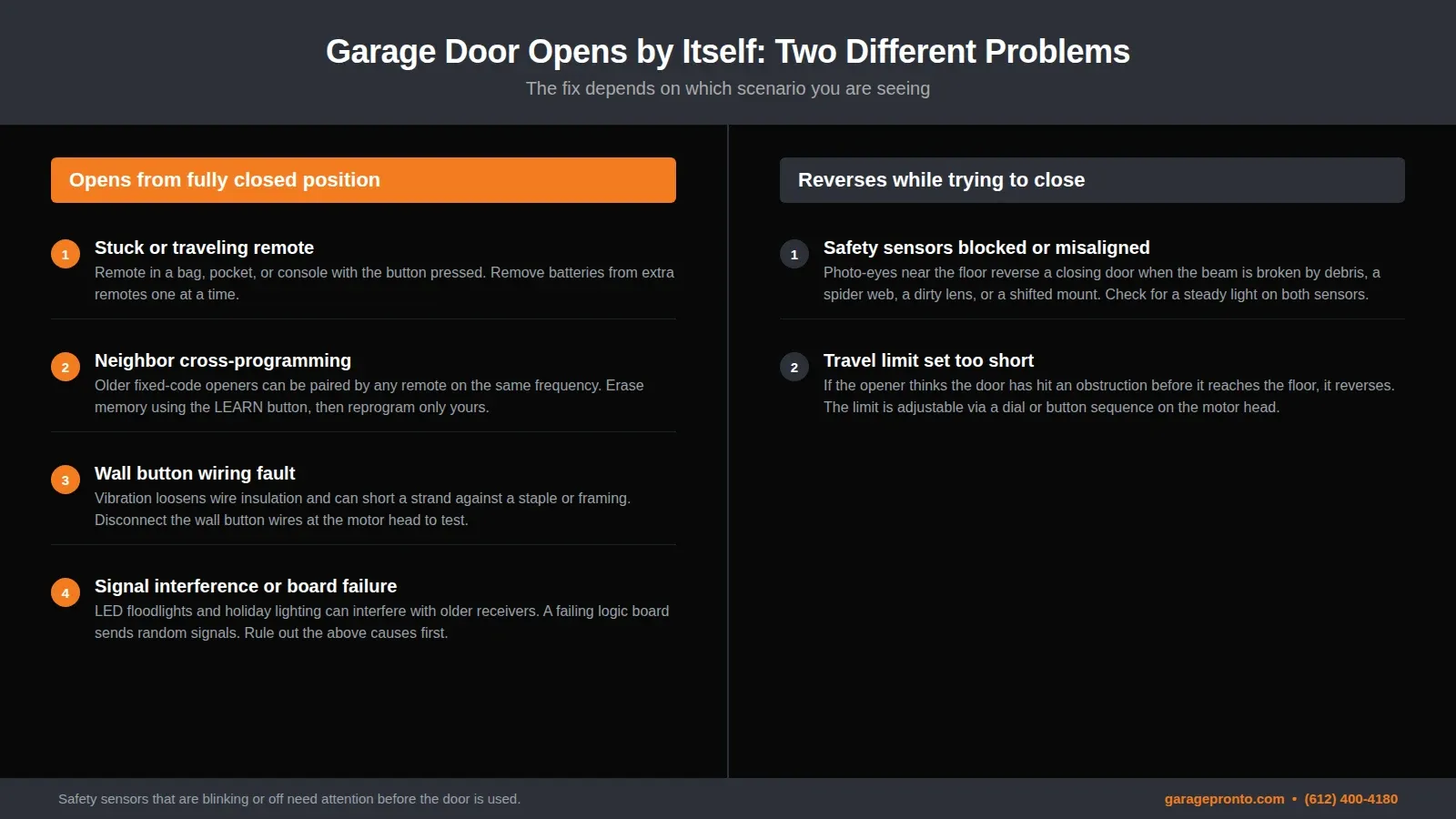
A garage door that opens by itself is almost always doing one of two distinct things: opening from a fully closed position without anyone pressing a button, or reversing back up while it is trying to close. Those two symptoms usually point to different causes, so the first step is to notice which one you are dealing with. Opens-from-closed points to a remote, a neighbor's device, a wiring fault, or a logic board. Reverses-while-closing points to the safety sensors or the travel limit setting.
Work through the checks below in the order they appear. Most take a few minutes and need no tools. If the opening happens at a predictable time each day, also check whether your opener has a timer-to-close feature that may be active.
When the door opens from a fully closed position
1. A stuck or traveling remote
The most common reason a door opens from a fully closed position is a remote that is sending a signal without anyone pressing it on purpose. A remote left in a coat pocket, sitting in a car console, or placed next to something heavy can get its button pressed. Cold weather can also cause a button to stick in the down position, particularly in older remotes that have seen a few Minnesota winters. Remove the batteries from every remote except the ones you use daily and see whether the openings stop. If they do, test each remote one at a time by inserting its batteries, waiting a day, and watching for the problem. That approach will identify exactly which remote is at fault.
2. A neighbor's device paired to your opener
Older garage door openers, particularly those more than 15 to 20 years old, use a fixed-code radio frequency. Any remote set to the same code, including a neighbor's, will trigger your opener. Modern openers use rolling codes that change with every press, which eliminates this problem entirely. If you have an older fixed-code opener and a neighbor recently bought a used car that came with a remote, that could be the source of your phantom openings. To test: erase all paired remotes on your opener by holding the LEARN button on the motor head for about 10 seconds until the indicator light turns off, then reprogram only your own remotes from scratch. If the openings stop, an unauthorized remote was the cause.
3. A wall button or wiring fault
The two-wire low-voltage circuit connecting the wall button to the opener can develop faults that send a false open signal. Door vibrations wear the insulation where the wire is stapled to the wall or framing, and over time a strand can short against the staple or against bare drywall. The clearest sign is a door that opens at no particular time and with no pattern to it. The quickest isolation test is to find the wall button terminal block on the opener motor head, usually two small screws or a quick-release connector with one or two wires attached, and disconnect those wires. Leave them loose and watch whether the phantom openings continue over the next day or two. If they stop, the problem is in the wiring or the wall button itself, not the remotes or the board.
4. Signal interference or a failing logic board
Certain LED floodlights and string lights, particularly older or budget LED products that emit radio frequency noise in the 310 MHz to 390 MHz range, can interfere with older fixed-code or unshielded opener receivers. This is worth considering in November and December when holiday lights go up around the Twin Cities. If the openings started when you changed a bulb or added lights, that is a strong clue. Swapping to a different LED brand, moving the opener antenna away from fluorescent or LED fixtures, or relocating the opener antenna itself can resolve it. If you have ruled out remotes, wiring, and interference, the remaining cause is usually a failing logic board inside the opener. Circuit boards can degrade after power surges or simply with age, and at that point a board replacement or a full opener replacement is the right call.
When the door reverses while it is trying to close
1. Safety sensors blocked or misaligned
Every residential garage door opener made after 1993 has a pair of safety photo-eye sensors near the bottom of each track. If the beam between them is broken by an object, a spider web, dirt on the lens, or a sensor nudged out of alignment, the opener reverses the door as a safety measure. This looks like the door is opening on its own when you are watching from outside, but the opener is working as designed. Check both sensors: when they are aligned correctly, one has a solid green light and the other a solid amber light. A blinking or absent light means the beam is broken. Clear any debris, wipe the lenses with a dry cloth, and gently adjust the sensor bracket until both lights are steady. If the bracket has broken or the sensor has been hit by a car bumper, the sensor will need to be replaced. See our safety sensor service page for what that job involves.
2. Travel limit set too short
A travel limit tells the opener how far down the door needs to travel before it is considered fully closed. If that limit is set too short, the opener thinks the door has hit an obstruction before it reaches the floor and reverses it as a protective measure. This is adjustable on most openers through a small dial or a button sequence described in the owner's manual. The giveaway is a door that consistently reverses at the same point above the floor, say six or eight inches off the ground, every single time. If the reversal point is consistent rather than random, adjust the close travel limit in small increments until the door fully contacts the floor before stopping.
When the opener itself is the cause
If you have isolated every remote, disconnected the wall button, confirmed the sensors are aligned, and confirmed the travel limit is correct, the remaining cause is usually the opener's logic board. Circuit boards can fail gradually, particularly on openers that have been through many Minnesota winters and power fluctuations. A partial board failure can cause random false open signals, cause the opener to respond to frequencies it should ignore, or trigger the door at unpredictable intervals. At that point the fix is typically a board replacement, and in many cases it makes more sense to replace an opener that is already 10 to 15 years old rather than pay for a board on aging hardware. Our guide on when to replace a garage door opener covers the signs it is not worth repairing.
How to isolate the wall button wiring in two minutes
Because wiring faults are common and easy to test without tools, this is worth doing early in your diagnosis rather than last. With the door fully closed, go to the opener motor head on the ceiling and find the wall button terminal: usually labeled as "wall" or "push" on the board, with one or two thin wires attached. Disconnect those wires and tuck them aside so they cannot contact each other or the motor housing. Now watch whether the phantom openings continue over the next 24 hours. If they stop, the problem is definitely in the wall button circuit, either the button itself or the wire run to it. If the openings continue with the wall button disconnected, the problem is a remote, a neighbor's paired device, signal interference, or the board. This single test cuts the diagnostic down by half and usually costs nothing.
When to call a technician
Call when the isolation tests above have ruled out remotes and the wall button, when you suspect a logic board failure, or when the sensors are physically damaged or their mounting bracket has broken. A Pronto technician can confirm the cause, replace the sensor, reprogram the opener, or replace the board in a single visit. Pronto covers Minneapolis, St. Paul and the surrounding Twin Cities suburbs seven days a week, with same-day service usually available. For typical repair costs across all repair types, our repair cost guide covers the common items.
Frequently Asked Questions
Why does my garage door open by itself in the middle of the night?
The most likely causes of late-night openings are a timer-to-close feature that you may not realize is active, a wiring fault that triggers without any external cue, or a neighbor's older fixed-code remote. Check your opener settings for a timer function first. If none is active, disconnect the wall button wires at the motor head and watch whether the openings stop over the next day.
Can a neighbor's remote open my garage door?
Yes, if your opener uses a fixed code rather than a rolling code. Fixed-code openers, common on units more than 15 to 20 years old, respond to any remote set to the same frequency and dip-switch pattern. Rolling-code openers change their code with every press and cannot be triggered this way. Erasing all pairings by holding the LEARN button for 10 seconds and then reprogramming only your own remotes will remove any unauthorized devices.
Why does my garage door start to close and then reverse open?
A door that closes partway and reverses is almost always a safety sensor problem. The two photo-eye sensors near the bottom of the tracks detect anything crossing the beam, including a spider web, insects, a shifted sensor mount, or a dirty lens. When the beam is broken, the opener is designed to reverse the door. Check both sensors for a solid steady light on each one. A blinking light means they are not aligned or the beam is obstructed.
Why does my LiftMaster garage door keep opening by itself?
LiftMaster openers made after roughly 2011 use Security+ 2.0 rolling codes, so neighbor cross-programming is not normally the cause. The more likely culprits on a LiftMaster are a wall button with a stuck or sensitive contact, a wiring short from door vibration, a timer-to-close setting turned on (check the MyQ app or the wall console), or a MyQ scheduling automation sending an open command. Disconnecting the wall button wires at the motor head is the fastest way to tell whether the button is responsible.
Is it safe to use a garage door that opens by itself?
It depends on the cause. If a remote or wiring fault is triggering the door, the door itself is mechanically sound. The main concern is security while the door is unattended. If the door is reversing because of a sensor problem, do not defeat or bypass the sensors. They prevent the door from closing on a person or a vehicle. Leave the door closed and have the sensor looked at before using the opener again.
Garage Door Still Opening on Its Own?
Call (612) 400-4180 or request a free quote. Same-day service across the Twin Cities, 7 days a week.