Garage Door Roller Replacement: When to Do It and What It Costs
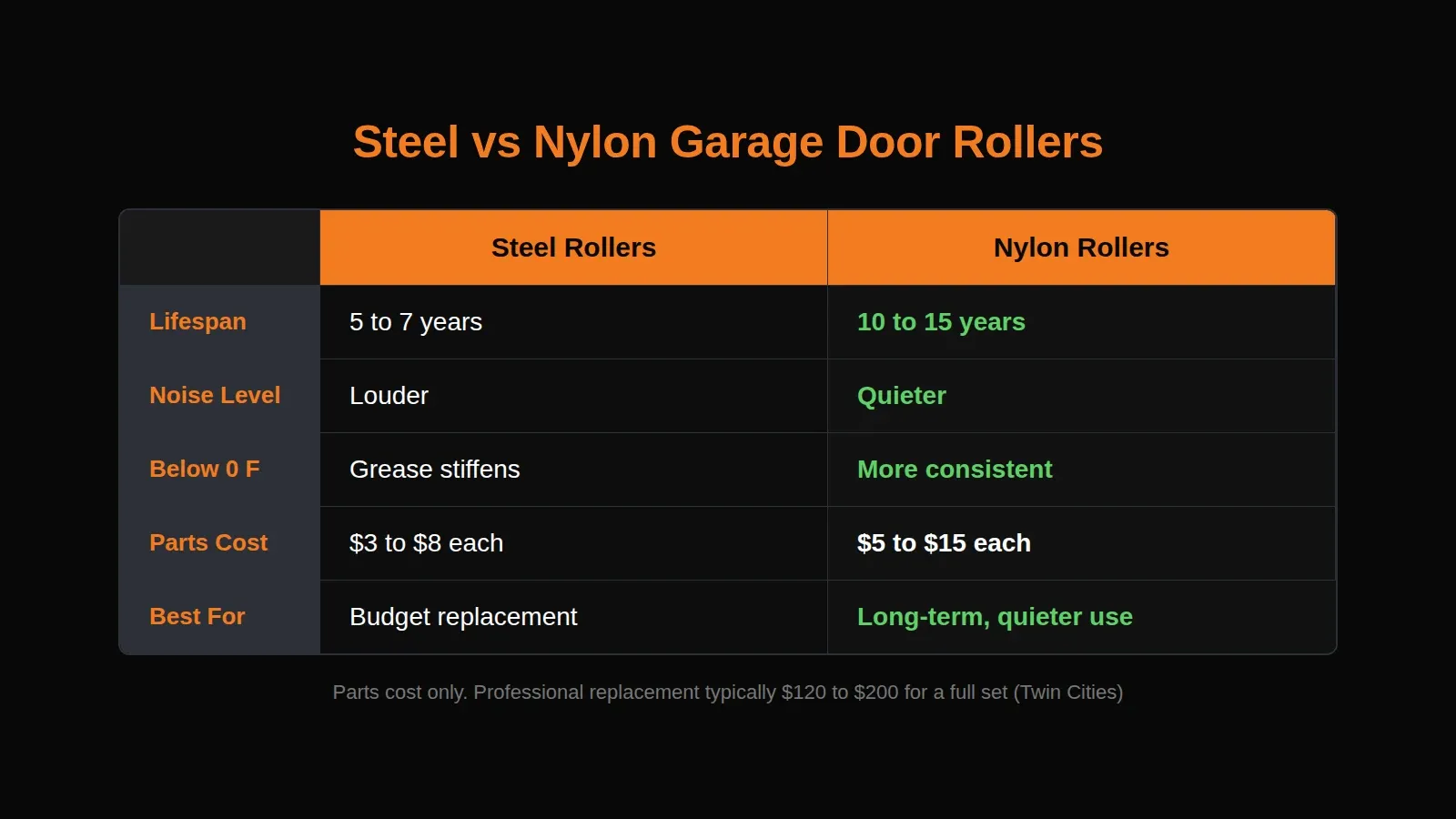
Garage door rollers typically need replacing every 5 to 7 years on steel and every 10 to 15 years on nylon, depending on how often the door cycles and whether the hardware gets lubricated regularly. When rollers wear out, the door grinds, rattles, or bounces in the track. A full set replacement on a two-car door runs roughly $120 to $200 in the Twin Cities for professional labor and parts, depending on the roller type and how many are worn.
This guide covers the signs of worn rollers, how steel and nylon compare during Minnesota winters, and what to expect from professional service versus a DIY repair.
What garage door rollers do and why they wear out
Rollers are the small wheels that ride inside the vertical and curved sections of the track. A standard two-car door has 10 to 12 rollers total: two per horizontal section across four or five sections, plus two bottom rollers bolted to the bracket where the lift cable connects to the door. Every time the door opens or closes, each roller completes one full cycle. A door that runs four times a day puts roughly 1,500 cycles on each roller per year.
Wear comes from friction and contamination. Steel rollers use ball bearings that collect grit from the track, road salt, and the slush that gets tracked in through a Minnesota winter. Nylon rollers run on sealed bearings or a solid nylon wheel, so they pick up less debris. Both types degrade faster when they run dry, which is why a twice-yearly application of garage door lubricant makes a real difference in lifespan.
Steel vs nylon rollers: what changes in Minnesota winters
Most garage doors built before the mid-2000s came with steel rollers as original equipment. They are inexpensive to replace and easy to find, but they are louder than nylon and get noisier as temperatures drop below zero. Grease thickens in the cold and stops distributing into the bearings properly, so the rollers run dry for a few cycles until the garage warms up. That dryness accelerates wear.
Nylon rollers are quieter at all temperatures and handle freeze-thaw cycles better because the wheel material does not change size as dramatically with temperature swings. The initial cost per roller is higher, but they last roughly twice as long, so the lifetime cost is similar or lower. For most Minnesota garages that see sustained cold from November through March, nylon is the practical upgrade when doing a full replacement.
| Feature | Steel rollers | Nylon rollers |
|---|---|---|
| Typical lifespan | 5 to 7 years | 10 to 15 years |
| Noise level | Louder, especially in cold | Quieter at all temperatures |
| Below 0 F | Grease stiffens in bearings | More consistent year-round |
| Parts cost (each) | $3 to $8 | $5 to $15 |
| Best fit | Budget replacement or older door | Long-term, quieter operation |
Signs your garage door rollers need replacing
Rollers give clear signals before they fail completely. Grinding or a high-pitched squeal that does not go away after proper lubrication usually means the bearing inside the roller has worn down. A door that bounces or shakes as it travels has a roller that is cracked or has gone flat on one side. If you spot white powder below the track, nylon rollers are shedding material. Black grit on steel doors means the bearing cage is breaking up.
- Grinding or squealing that continues after lubrication with a proper garage door lubricant (not WD-40, which washes out existing grease)
- Visible cracks, chips, or flat spots on the roller wheel
- The door wobbles or shakes during travel
- White powder (nylon) or black grit (steel) on the floor below the tracks
- The door drifts off-center or tilts to one side as it opens or closes
A door that has gone off-track is a separate repair, but worn rollers that allow the door to wobble sideways are one of the more common contributing causes. See our off-track repair page for what that job typically involves.
How many rollers does a garage door have
A single-car door (around 9 feet wide) typically has 10 rollers: two per horizontal section across four sections, plus the two bottom rollers. A two-car door (around 16 feet wide) usually has 12, with an extra section. Some heavier wood panel doors from the 1970s and 1980s have more.
Whether to replace one roller or the full set depends on what caused the failure. If a single roller was knocked out of the track by a car bumping the door, replacing just that roller is fine. If two or more rollers are cracked or worn flat, they are likely the same age and the rest of the set is not far behind. Replacing the full set while a technician is already on-site avoids a second service call within a year. When in doubt, ask the tech to check each roller while they are there.
What roller replacement costs in the Twin Cities
Part costs at hardware stores run $3 to $8 per roller on steel and $5 to $15 per roller on nylon. A full set for a two-car door is $35 to $180 in parts alone, depending on grade. Higher-end nylon rollers with sealed 6200ZZ bearings run toward the top of that range but are rated for 20,000 cycles or more, which at four cycles per day works out to about 14 years.
Professional labor in the Twin Cities typically runs $120 to $200 to replace a full set, parts included. These are typical market ranges, not Pronto-specific pricing. Several factors move the number: how many rollers need replacing, whether the bottom bracket rollers require cable management, and whether the technician adjusts the tracks while on-site. Pronto provides upfront, flat-rate pricing before any work starts, so you know the cost before the job begins.
For a broader breakdown of what garage door repairs cost across different repair types, the garage door repair cost guide covers typical Twin Cities ranges.
Can you replace garage door rollers yourself
Most of the rollers on a garage door are straightforward DIY with the door fully closed. Each roller sits inside a hinge bracket. You unbolt the two hinge bolts, tip the roller out of the track slot, slide in the replacement, and re-bolt. A socket wrench is the only tool needed. The upper and middle section rollers work this way.
The bottom two rollers attach to the bottom bracket, which is also where the lift cable connects to the door. On a door with healthy springs and the door fully closed, there is minimal tension on the bottom bracket, and swapping the roller is manageable. The complication: if a spring is weak or close to breaking, the cable can still have load on it. If you are not sure about the spring condition, or if the cable looks frayed or has visible kinks, leave the bottom brackets for a technician. Cable hardware under spring tension can cause serious injuries when it lets go.
One thing that catches Minnesota homeowners off guard: do not lubricate rollers that are frozen in place or still ice-cold from an overnight freeze. Let the door warm up for a few minutes first, then apply lubricant. Lubricating a frozen bearing can trap moisture inside and speed up rust. Our lubrication guide covers which products work and which to skip.
When to call a technician
Call if multiple rollers are cracked or if you see any cable fraying near the bottom brackets. Also call if the door tracks crooked after a roller swap, since that points to a track alignment issue the roller change did not fix, or if the spring area shows any visible damage. A safety inspection and tune-up includes checking all rollers, hinges, cables, and springs in one visit, so if you are not sure what is worn, that is a reasonable starting point before committing to a specific repair.
Pronto serves Minneapolis and the surrounding Twin Cities metro seven days a week, usually the same day you call. Call or text (612) 400-4180 for a free estimate, or request a quote online.
Garage Door Roller Replacement: Common Questions
How long do garage door rollers last?
Steel rollers typically last 5 to 7 years. Nylon rollers last 10 to 15 years. Both last longer with regular lubrication and on doors that run no more than 4 to 5 cycles per day. Minnesota winters shorten steel roller life because grease stiffens in the cold and the bearings run dry until the garage warms up.
What is the difference between steel and nylon garage door rollers?
Steel rollers are cheaper but louder and more sensitive to cold temperatures. Nylon rollers run quietly at all temperatures, handle freeze-thaw cycles with less wear, and last significantly longer. The parts cost is higher for nylon, but the longer service life makes the total cost comparable or lower over the life of the door.
Can I replace just one garage door roller, or should I replace all of them?
If one roller was physically damaged by an impact, replacing just that roller is fine. If two or more rollers are cracked or worn, they are probably all the same age and close to failure. Replacing the full set while a technician is already there saves a second service call within the year.
What does garage door roller replacement cost in Minnesota?
Professional replacement in the Twin Cities typically runs $120 to $200 for a full set, including parts and labor. Steel roller parts run $3 to $8 each; nylon parts $5 to $15 each. A single-roller repair costs less. Pronto provides a flat-rate quote before any work begins.
Why is my garage door still noisy after I lubricated the rollers?
Lubrication helps dry bearings but cannot fix a cracked or worn wheel. If the grinding continues after a proper application of garage door lubricant, check the roller wheel for visible cracks or flat spots. A flat or chipped wheel creates a thump or bounce with every rotation, and no amount of lubrication fixes that. The roller needs replacing.
Need Roller Replacement in the Twin Cities?
Call (612) 400-4180 or request a free quote. Same-day service across the Twin Cities, 7 days a week.