Garage Door Remote or Keypad Not Working? Start Here
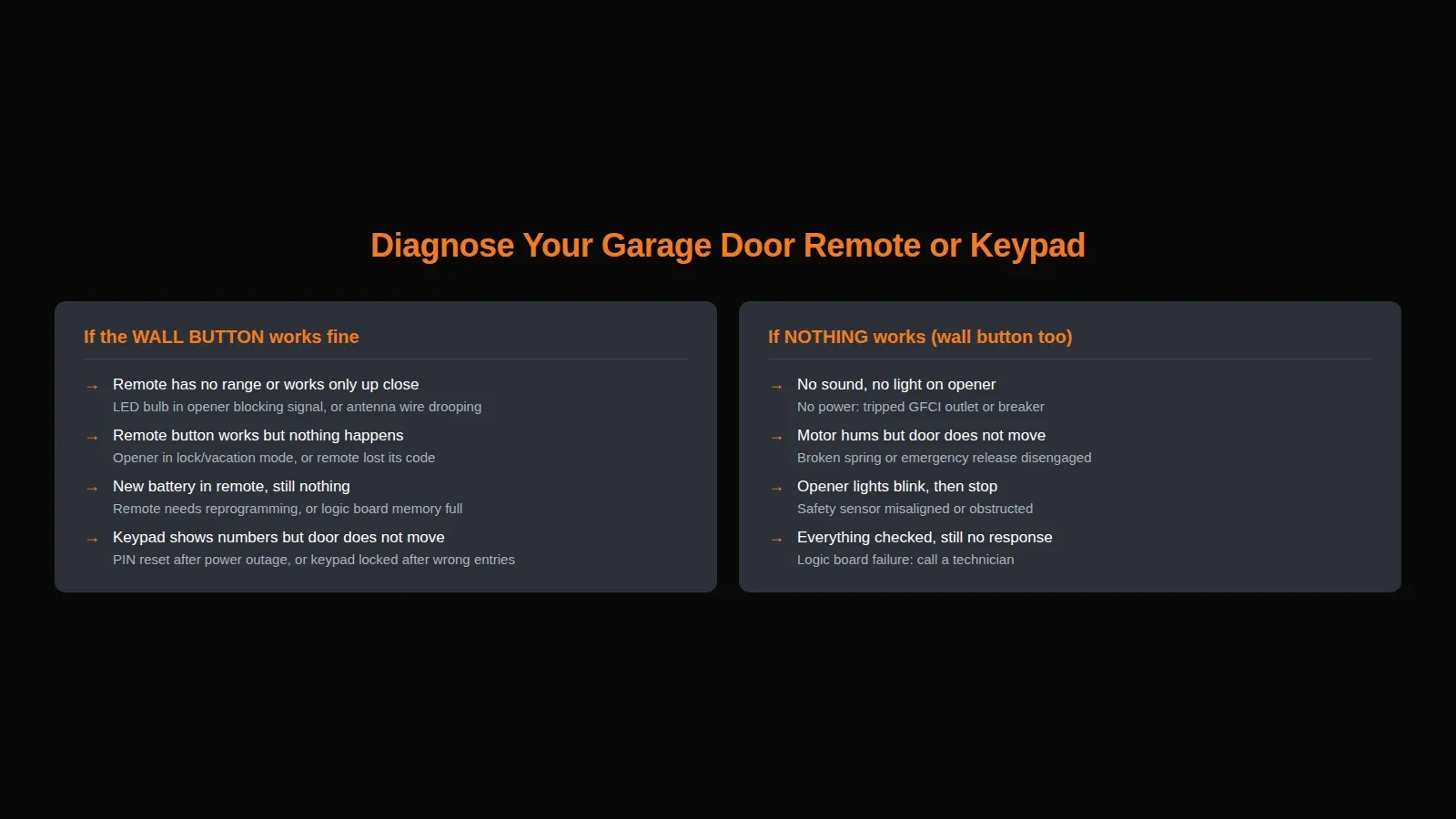
If your garage door remote or keypad stopped working, the most likely cause is a dead or weakened battery, the opener in lock mode, or a remote that lost its code after a power outage. If the wall button still works, the opener is fine and the problem is in the remote, keypad, or the signal path. If the wall button is also dead, the issue is with the opener itself or its power supply. The checks below split those two paths and walk through each one in order of how often they actually cause this in Minnesota homes.
Work through the path that fits your situation. Most of the first three checks take under two minutes and need no tools.
Start with this question: does the wall button work?
| What you notice | Most likely cause | Where to look |
|---|---|---|
| Wall button works, remote does not work at all | Dead battery, lost code, or lock mode | Sections 1 through 3 below |
| Wall button works, remote only works very close to the opener | LED bulb interference or drooping antenna wire | Sections 4 and 5 below |
| Keypad lights up but door does not move | Wrong PIN after power outage, or keypad lockout | Section 6 below |
| Nothing works, opener light is off | No power to the opener | Check GFCI outlet and breaker |
| Nothing works, opener hums but door does not move | Broken spring or disengaged trolley | See below, call a technician |
1. Replace the battery, and do it correctly
A weak battery is the most common cause of a remote that stops working or only works when you are standing directly under the opener. Most remotes use a CR2032 or CR2016 coin cell, though some older LiftMaster and Genie remotes use AA or AAA cells. Check the battery type before buying a replacement.
Two things make this check fail even when the battery is new. First, battery contacts inside the remote can develop a thin layer of corrosion, especially in an unheated garage where temperature swings cause condensation. Wipe the contacts with a dry cloth or a cotton swab before installing the new cell. Second, coin-cell batteries lose capacity faster in the cold. In a Minnesota winter, a battery that tested fine in the fall may read 2.8V but deliver only 40 percent of its rated current when the garage is below freezing, which is not enough to fire the transmitter reliably. Replace it rather than test it.
2. Check whether the opener is in lock mode
LiftMaster, Chamberlain, and Genie openers all include a lock or vacation mode that disables every remote and keypad in the system while leaving the wall button active. This is the feature that protects the door while you are traveling, and it is easy to activate by accident by pressing and holding the wrong button on the wall console.
Look at the wall console. If the lock button is lit, or if a small padlock icon is showing, hold that button for two to three seconds. The light should turn off and the remote should work again. On older consoles without a display, a rapidly blinking light on the motor unit is often the sign that lock mode is on. Consult the opener manual for your specific model if you are not sure which button controls it.
3. Reprogram the remote to the opener
Remotes and openers sometimes lose their pairing after a power outage, after a surge, or simply because the opener's memory was cleared during a service call. Reprogramming takes about 30 seconds.
Find the learn or program button on the motor unit. It is usually on the back or side of the opener, and it is often a small square or round button next to a blinking LED. Press and release it. The LED will either blink or stay on for about 30 seconds. Within that window, press and hold the button on your remote until the opener light flashes or you hear two clicks. The remote is now paired.
One note worth knowing: LiftMaster and Chamberlain openers manufactured after 2011 use Security+ 2.0 technology and store up to 40 individual remote codes. If the memory is full, a new remote will not pair until you clear the old codes. Holding the learn button for about six seconds until the LED turns off erases all stored remotes, then you can start fresh. This is not something you need often, but it explains the rare case where reprogramming simply does not take.
4. Check for LED bulb interference
This is the cause that surprises most homeowners. Standard LED bulbs inside the opener housing emit radio frequency noise that can block or shorten the range of the 315MHz or 390MHz signal your remote uses. It is a real and documented issue with many common LED replacement bulbs, and it became more common as homeowners started swapping out incandescent bulbs in the early 2020s.
Test it by removing the bulb from the opener housing and trying the remote. If the range improves immediately, the bulb is the problem. Replace it with a bulb labeled as compatible with garage door openers, or simply use an incandescent bulb in that specific socket. The two bulb slots in a standard opener housing are not the place to install the most efficient LED you can find.
5. Check the antenna wire on the motor unit
The opener has a short wire antenna that hangs from the motor unit, usually a few inches of coated wire near the learn button. If this wire has been coiled up, tucked out of the way, or cut, the range drops significantly. The antenna should hang straight down. If it is looped, straighten it. If it is cut or missing, a technician can replace it during a opener repair visit.
Range also shrinks in cold weather because the transmitter in the remote runs at a lower voltage when the battery is partly drained. If the remote works in warm weather but struggles in January, a fresh battery and a straight antenna are the first two checks.
6. Keypad not working: the checks that differ from a remote
A keypad that lights up but does not move the door usually points at one of three things.
- Wrong PIN after a power outage. Power outages can wipe the keypad PIN on some models while leaving the opener itself functional. You will need to reprogram the PIN using the learn button on the motor unit and the keypad setup sequence for your brand. Genie and LiftMaster keypads each have slightly different procedures, so check the manual or the manufacturer's support site for the exact steps.
- Keypad lockout. Many keypads lock themselves after three to five incorrect PIN entries as a security measure. Wait about 30 seconds, or hold the asterisk or pound key for two seconds, then try again.
- Dead keypad battery. The backlight may still illuminate on a low battery but the transmitter does not have enough power to send the signal. Replace the battery in the keypad itself (usually a 9V or AA cells depending on the model) and test again.
If the keypad still does not respond after a fresh battery and a PIN reset, the keypad unit may need to be replaced. They are inexpensive, and swapping one usually takes 10 minutes.
When neither the remote nor the wall button works
If both the remote and the wall button fail at the same time, the problem is upstream of the remote. Start with power: garage outlets are often on a GFCI circuit, and the reset button may be on an outlet elsewhere in the garage or outside near the service door. Press it and check the breaker. If power is confirmed, the opener logic board may have failed, often after a power surge. That is a job for a technician. For a broader look at the full set of reasons a door will not respond, our garage door won't open checklist covers every cause from power to springs.
When to call a technician
Call if you have worked through all five checks above without finding the cause, or if the opener motor hums when you press the button but the door does not move. A hum with no movement usually means a broken spring, not a remote issue. Springs hold the full weight of the door under tension, and they are not a DIY fix.
A safety inspection and tune-up is also worth scheduling once a year in Minnesota. Cold weather stiffens rollers and thickens grease, which increases the load on the opener and speeds up wear on the remote's transmitter over time. Pronto serves Minneapolis, St. Paul and the Twin Cities metro seven days a week, usually the same day you call. Reach us at (612) 400-4180. Upfront, flat-rate pricing is quoted before any work starts, and estimates are free.
Garage Door Remote Not Working: Common Questions
Why does my garage door remote not work even with a new battery?
A new battery fixes the power issue but not a lost code or LED interference. If the new battery does not help, check whether the opener is in lock mode, try reprogramming the remote using the learn button on the motor unit, and remove the LED bulb from the opener housing to test for radio interference. Those three causes account for most cases where a battery swap alone does not solve the problem.
Why does my garage door remote only work when I am right next to the opener?
Short range almost always points at one of two things: an LED bulb inside the opener blocking the radio signal, or the antenna wire on the motor unit coiled up instead of hanging straight. Remove the bulb and straighten the wire, then test. A battery that is low in cold weather can also cut range significantly.
Does a power outage reset garage door remotes?
Usually no. Most openers keep the remote codes stored in non-volatile memory that survives a power loss. The exception is if someone held the learn button during the outage or just after, which clears the memory. Keypads are more likely to lose their PIN after an outage on certain models. If your remote stopped working after a power outage, try reprogramming it before assuming the opener is damaged.
How do I get into my garage if the remote stops working?
Use the wall button inside the garage if it is accessible, or use the exterior keypad if it has a working battery and PIN. You can also pull the emergency release cord from inside the garage to disconnect the door from the opener and lift it by hand. If you are locked out completely, call a technician rather than trying to force the door, which can damage the track or panels.
How long do garage door remote batteries last?
A typical coin-cell battery in a garage door remote lasts one to three years under normal use. In Minnesota, batteries in unheated or minimally heated garages can drain faster because cold temperatures reduce the battery's output current. If you press the button more times than usual to get the door to respond, replace the battery soon rather than waiting for it to fail completely.
Remote Still Not Working?
Call (612) 400-4180 or request a free quote. Same-day service across the Twin Cities, 7 days a week.