Garage Door Stuck Open: What to Check First and How to Secure It
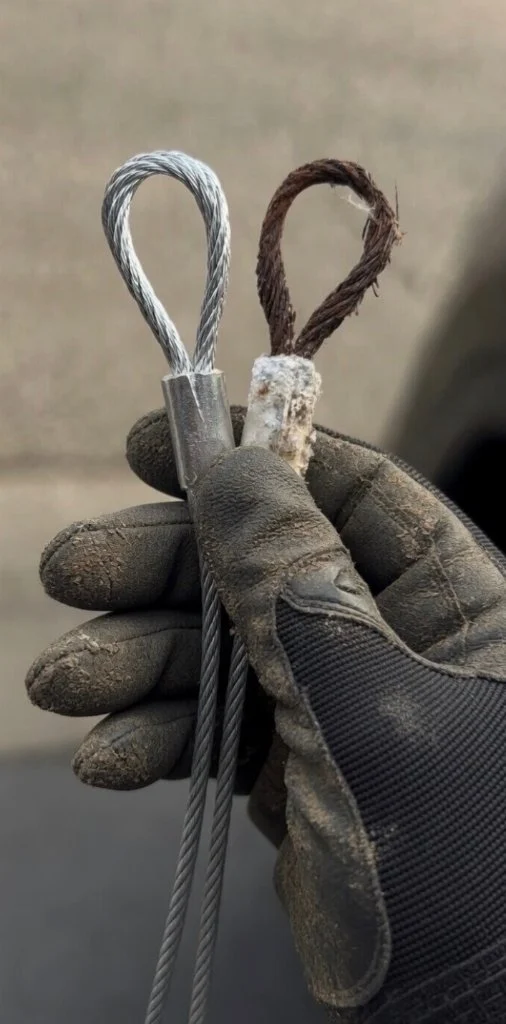
A garage door stuck open is usually caused by one of four things: a safety sensor that is blocked or misaligned, an opener that has lost its settings, a broken torsion spring, or a snapped lift cable. Before you press the button again or try to pull the door down by hand, look at the cables on each side and the spring above the door. If either looks damaged or out of place, stop and call a technician. If both look normal, the fix is often something you can handle in a few minutes.
Work through the checks below in order. The first two are safe for any homeowner. The third tells you when to stop and call.
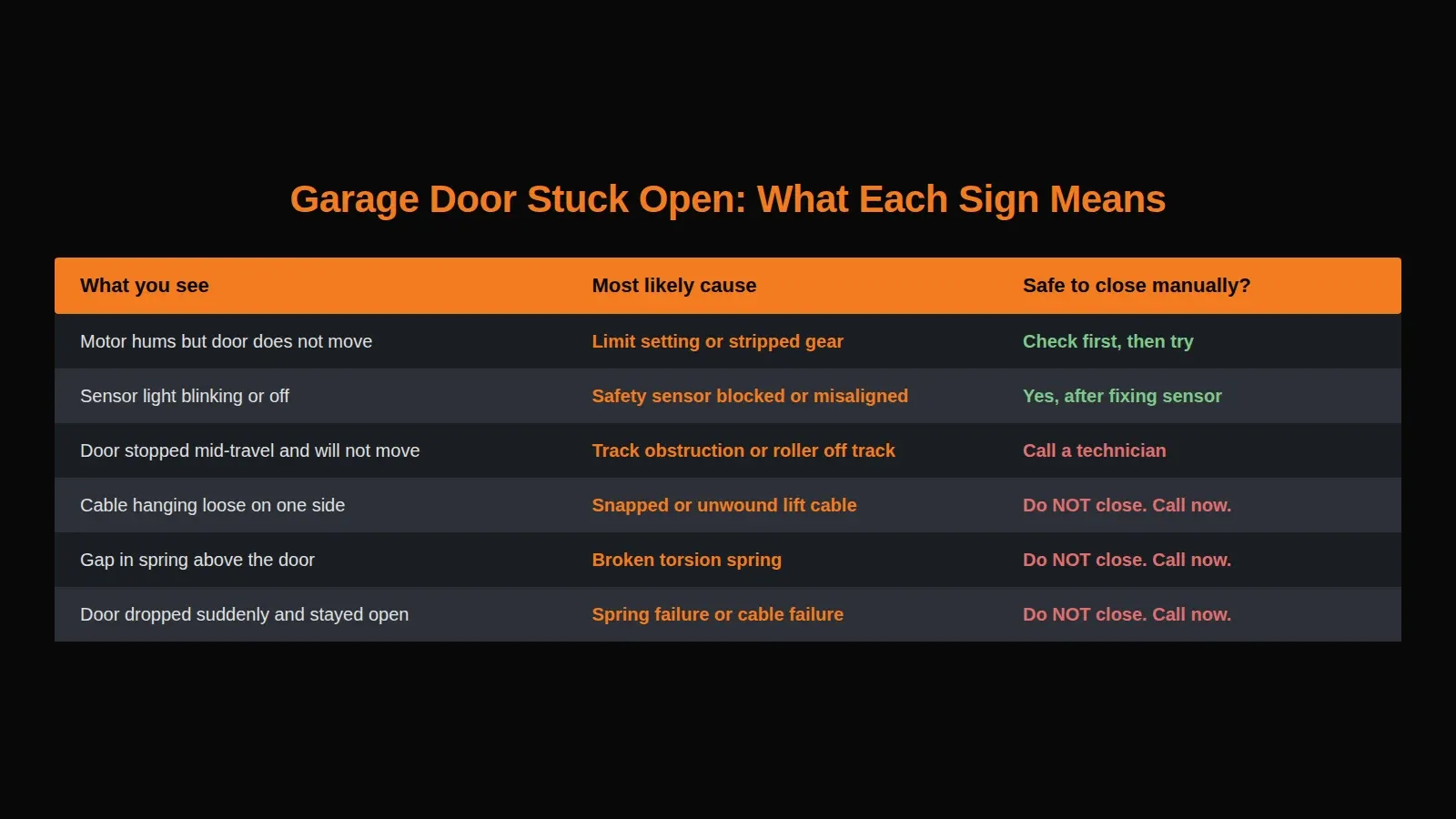
What each sign means
Look at the cables and the spring before you do anything else
Stand inside the garage and look at the two cables running from the bottom corners of the door up to the drums at the top. A healthy cable is taut and neatly wound on its drum. If a cable is hanging loose, pooled on the floor, or looks like a pile of wire, do not touch the door. The cable has failed under spring tension, and the door is now unbalanced and dangerous to move.
Next, look at the torsion spring. This is the horizontal spring mounted on the tube above the door opening. It should be one continuous coil with no visible separation. A broken spring will show a gap of an inch or more somewhere along its length. The door may have dropped suddenly when the spring broke, which often sounds like a sharp bang inside the garage.
If either the cable or the spring looks wrong, leave the door where it is, keep the interior door to the house locked, and call for spring repair or cable repair. Attempting to close a door with a broken spring or snapped cable by hand can release stored tension without warning.
Safe checks to run if the cables and spring look fine
Check the safety sensors first
The two photo-eye sensors sit near the floor on each side of the door, roughly four to six inches off the ground. They send an invisible beam across the opening. If anything breaks that beam, or if the lenses are dirty or misaligned, the opener will refuse to close the door as a safety measure. Look at the small indicator lights on each sensor. On most LiftMaster and Chamberlain openers, one side shows a steady green or amber light and the other shows a steady green. A blinking or unlit light means that sensor is the problem.
Clear any cobwebs, leaves, or dirt from the sensor lenses. Check whether they are aimed at each other. The sensors mount on small adjustable brackets and one can get bumped off-axis by a car, a snow shovel, or a broom handle. Once both lights are steady, press the close button. Safety sensors are the most common cause of a stuck-open door that is otherwise mechanically sound. If the sensors keep drifting or failing, sensor replacement is a straightforward repair.
Try a power cycle on the opener
If the sensors look fine, unplug the opener from the ceiling outlet for about thirty seconds and plug it back in. This clears the logic board and resets the travel limits, which can drift after a power surge or after the door was forced past its set point. Run the opener through a full open and close cycle after the reset. On some openers the limits drift far enough that the motor thinks the door is fully open when it has actually reached the travel limit but not the full-close position. A power cycle corrects this.
If the opener makes no sound and no light comes on after you plug it back in, the control board may have failed and you will need opener repair.
Look in the tracks for debris or a displaced roller
Run your eyes along both tracks from top to bottom. A pebble, a chunk of ice, or a section of bent track can stop a roller mid-travel and leave the door stuck partway up. If you see loose debris, remove it. Do not try to hammer out a bent section of track yourself. The bend needs to be corrected squarely or the door will bind in the same spot every time. A bent track is a job for a technician.
How to close the door manually when it is safe
If the cables and spring are intact and the powered close still does not work, you can try to lower the door by hand. Pull the red emergency release cord hanging from the rail to disconnect the door from the opener trolley. With the door in the up position, grip the handle or the bottom bar and pull down steadily. The door should lower smoothly. If it feels very heavy or drops faster than you expect, stop. That is a sign the springs are worn or already failing.
Once the door is down, pull the release cord toward the door to re-engage the trolley, or run the opener and it will click back into place on its own. The door will not be motorized again until that connection is made.
If the door cannot close, here is how to secure the house tonight
A garage door stuck in the up position is a security concern, especially after dark. If the door cannot be safely closed and a technician cannot arrive until morning, lock the interior door between the garage and the living space. That door should have a deadbolt, and it should be engaged. Lock any side entry doors to the garage as well. Move valuables out of the car and, if practical, out of the garage entirely.
For same-day emergency service across Minneapolis and the Twin Cities, call or text Pronto at (612) 400-4180. Emergency calls are handled 24 hours a day, seven days a week, and response is usually within about 60 minutes. A door stuck open overnight is exactly what the emergency line is for.
Why stuck-open calls increase in fall and early winter
In the Minneapolis metro, Pronto receives more stuck-open calls in October and November than in any other two months combined. Two things drive this. First, torsion springs that were marginal through the summer are more likely to fail when outdoor temperatures drop sharply, because the metal contracts and a coil that was holding on in August may break on the first hard freeze. Second, cars bringing in slush and ice can knock sensors out of alignment at the threshold, and condensation on sensor lenses is more common as temperatures swing.
If your door starts acting unpredictably before winter, a tune-up and safety inspection is worth scheduling before the cold sets in. Pronto serves St. Paul, Minneapolis, and the surrounding Twin Cities suburbs seven days a week.
When to call a technician
Call if you see a broken spring, a loose or tangled cable, a roller that has come off the track, or anything inside the opener that does not look right. Also call if you have worked through all three checks above and the door still will not close. For typical repair costs before you call, the garage door repair cost guide covers Twin Cities price ranges for each type of repair. If the door has been refusing to close rather than refusing to open, see the safety sensor checklist for a deeper look at that specific problem.
Garage Door Stuck Open: Common Questions
What is the most common reason a garage door gets stuck open?
The most common cause is a blocked or misaligned safety sensor. The photo-eye sensors near the floor send a beam across the opening, and if anything breaks that beam or the lenses are dirty, the opener will not close the door. Check the indicator lights on each sensor and clear any obstruction before calling for service.
Can I manually close a garage door if the spring is broken?
No. A broken torsion spring means the door is carrying its full weight without any counterbalance. Garage doors typically weigh 150 pounds or more, and lowering one by hand without a working spring can cause it to drop suddenly. Leave the door in the up position and call a technician to handle the spring.
What should I do if my garage door is stuck open overnight?
Lock the interior door between the garage and the house, engage any manual locks on side entry doors, and move valuables out of the car. For emergency service in the Twin Cities, call Pronto at (612) 400-4180. Technicians are available 24/7 and typically arrive within about 60 minutes.
Will unplugging the garage door opener reset it and fix the problem?
Sometimes. A 30-second power cycle clears the logic board and resets the travel limits on most LiftMaster, Chamberlain, and Genie openers. If the door got stuck because the opener lost its limit settings after a power fluctuation, the reset often fixes it. If the door still will not close after the reset, the cause is elsewhere, typically the sensors, the springs, or a cable.
How do I know if my garage door spring is broken?
Look for a visible gap in the torsion spring above the door opening. A broken spring shows a separation of an inch or more somewhere along its coil. A loud bang you heard from the garage earlier is another reliable indicator. A door that suddenly feels extremely heavy to lift by hand, or that drops when you let go, points to a broken spring as well.
Garage Door Still Stuck Open?
Call or text (612) 400-4180. Same-day and 24/7 emergency service across the Twin Cities, 7 days a week.