Garage Door Insulation in Minnesota: Does It Make a Difference?
Yes, garage door insulation makes a real difference in Minnesota, particularly for attached garages where the door is the largest break in the thermal envelope between a heated living space and the cold outside. For a detached, unheated garage, insulation slows the overnight temperature drop but will not keep the space warm on its own. This guide covers what insulation actually does, what R-value means in a Minnesota winter, and when a purpose-built insulated door is a better choice than a retrofit kit.
What garage door insulation actually does
A standard two-car garage door is roughly 16 by 7 feet, about 112 square feet of surface. An uninsulated steel door sits at R-2 or less, meaning the panel surface drops close to outdoor temperature on a cold night. When that door separates the garage from the rooms beside or above it, those rooms feel it all winter.
Insulation reduces the rate of heat transfer through the panels. It does not eliminate it. The door still has seams at the edges, a weatherstrip that ages and compresses, and gaps at the top and bottom. But reducing heat transfer across 112 square feet of panel makes a measurable difference in how cold the garage floor gets and how much cold radiates into the adjacent wall.
What insulation does not do: it will not heat an unheated garage by itself. R-value measures resistance to heat flow, not the creation of it. In a detached garage with no furnace, the space will eventually reach outdoor temperature regardless of R-value. Insulation slows that process, which does matter for a parked car on the coldest nights, but it is not a substitute for a heat source.
R-value: what the numbers mean in practice
R-value is a measure of thermal resistance. Higher is better. Most residential garage doors fall into four ranges, from uninsulated steel to polyurethane-filled panels:
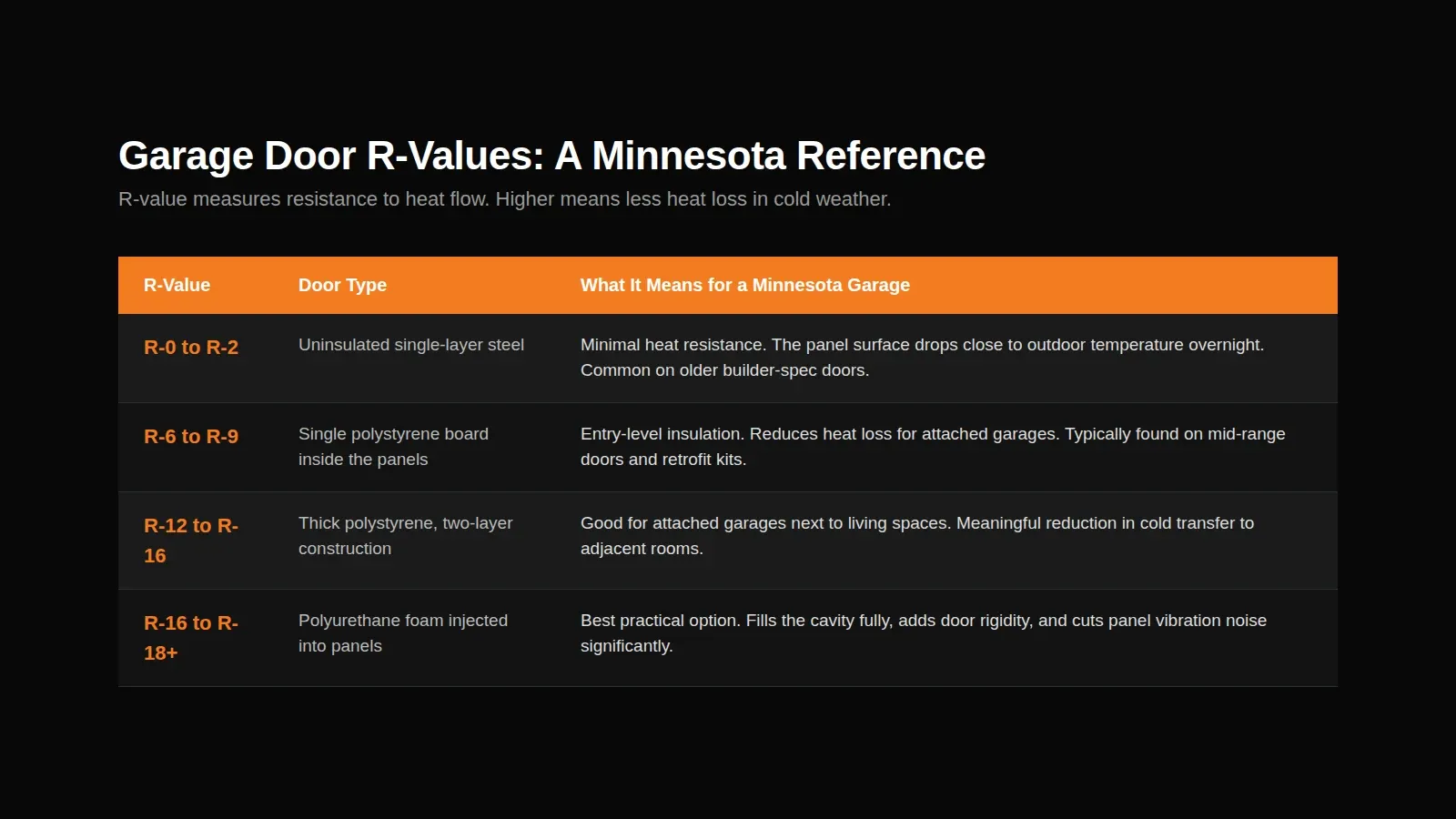
Polyurethane is the better insulator per inch. Manufacturers inject it directly into the panel cavity, where it expands and fills the space completely. That full fill also stiffens the door and dampens the metallic resonance that makes steel doors loud when wind hits them. Polystyrene comes as flat boards bonded or clipped into the panel; it is lighter and less expensive, but it leaves more air gaps and delivers a lower R-value per inch.
For an attached garage in Minnesota, R-12 is a reasonable floor. R-16 to R-18 is worth considering if the adjacent room is a bedroom or a frequently used living space. Above R-18, the price premium climbs quickly and the practical gain in a standard residential garage is small. At that point weatherstripping quality and frame sealing matter more than extra panel insulation.
DIY insulation kit versus buying an insulated door
Retrofit kits, sold at hardware stores in roughly the $50 to $150 range for a two-car door, use polystyrene foam panels or foil-faced bubble film that you cut and fasten to the existing door with tape or plastic clips. A standard uninsulated door at R-2 can reach R-4 to R-6 with a well-fitted kit. That is a real improvement, and for a door that is otherwise in good shape it is a reasonable option.
The main limitation is weight. A polystyrene kit adds roughly 8 to 14 pounds to a door that was designed and balanced without it. That extra load puts stress on the springs and can push the opener's force setting past its calibration. On a door that is already 8 to 10 years old, adding that weight is worth thinking through. A safety inspection before adding any kit can tell you whether the springs have enough service life left to handle the added load without adjustment.
Buying an insulated door means the panel weight is engineered into the door from the start, the R-value rating covers the whole door assembly, and the spring system is sized for it. The cost difference between an uninsulated and an insulated steel door on a standard two-car residential opening is often in the $200 to $400 range, which is a small fraction of total replacement cost. If the door is already due for replacement, choosing an insulated model is almost always the better decision. Our new door installation page covers what the process looks like from start to finish.
Which garages benefit most in Minnesota
Attached garages are the clearest case. The garage door is typically the weakest thermal point in the wall shared with the house. The room beside or above the garage is often the coldest room in the home during winter, and an upgrade from an uninsulated door to one rated at R-12 or higher makes a noticeable difference in that room's comfort.
Detached alley garages are common in older Minneapolis and St. Paul neighborhoods. Because these garages have no heat source, insulation alone will not hold the space above freezing in a Minnesota January. What it does do is slow the overnight temperature drop, and that matters for a car parked inside. Below roughly -10 degrees Fahrenheit, a cold-soaked battery can struggle to start even if it is fully charged. A garage that drops from -20F to -8F instead of -25F makes a real difference for starting a vehicle in the morning.
In any Minnesota garage, the bottom seal deserves as much attention as the panels. A worn or cracked seal lets cold air pour in at ground level and can freeze to the concrete slab overnight. A frozen seal is one of the most common causes of a door that will not lift in January. If a door replacement is on the table, replacing the bottom seal as part of that job is the right time to do it. For a fuller look at what Minnesota cold does to garage door hardware, see our post on Minnesota winter garage door problems.
Does an insulated door reduce noise
A practical side benefit: polyurethane-filled doors are noticeably quieter than uninsulated steel. The injected foam stops the panels from flexing and resonating, which cuts the low boom the door makes in wind and reduces the vibration that travels through the rail when the opener runs. If the garage is below a bedroom, a polyurethane door makes a real difference in noise. Polystyrene panels are quieter than bare steel but do not match polyurethane, because the boards do not fill the cavity as completely and some vibration still travels through the panel frame.
What to look for when comparing insulated doors
- R-value of at least R-12 for an attached Minnesota garage. Consider R-16 or higher if the space next to the garage is a bedroom or a room where temperature comfort matters.
- Insulation type: polyurethane injected into the panels outperforms polystyrene at the same thickness and adds rigidity and noise reduction.
- Steel gauge: heavier gauge steel (18 gauge or lower in number) holds its shape better through years of Minnesota temperature cycling from -30F to 90F.
- Weatherstripping on all four sides: a well-insulated panel in a leaky frame loses a large share of its thermal benefit at the edges and the bottom.
- Spring system sizing: a new door should come with a spring system rated for its weight. If you are upgrading from a lightweight uninsulated door to a heavier insulated one, confirm with the installer that the springs will be replaced or adjusted to match.
When to call a technician
If you add a kit to an existing door and afterward the door moves sluggishly, reverses on its own, or the opener sounds strained, the added weight has exceeded what the springs were calibrated for. Stop using the opener and call for a spring service to have the system rebalanced. Pronto covers Minneapolis, St. Paul, and the wider Twin Cities metro seven days a week. Call or text (612) 400-4180 or use the free quote form to get a same-day appointment.
Garage Door Insulation: Common Questions
Will an insulated garage door keep my garage warm in winter?
Not on its own. Insulation slows heat loss but does not generate heat. In an attached garage with a heating source nearby, a high R-value door helps that heat stay longer. In an unheated detached garage, insulation slows the overnight temperature drop but the space will still reach ambient outdoor temperature on a cold night.
Can I add a DIY insulation kit to any garage door?
Most retrofit kits are designed for standard raised-panel steel doors. Before adding one, check the kit's total weight against what your springs are designed to lift. Adding 10 or more pounds to a door near the end of its spring cycle can cause premature spring failure. On a door older than 8 to 10 years, a spring inspection before adding any kit is a good idea.
What R-value should I look for in a new garage door in Minnesota?
For an attached garage, R-12 is a practical minimum. R-16 to R-18 is worth the cost difference if the room next to the garage is a bedroom or a frequently used space. Focus on weatherstripping quality as well. A tight seal at the bottom and sides matters as much as the panel R-value for keeping cold air out.
Does an insulated garage door actually lower energy bills?
For an attached garage, yes, though the amount varies with garage size, how often the door opens, and the condition of the rest of the garage envelope. The clearest benefit is thermal comfort in the adjacent room rather than a large measurable change in the utility bill. An older uninsulated door in a garage under a bedroom is the case where the difference is most noticeable.
My insulated door still feels drafty. What should I check?
Check the side and top weatherstripping first. A worn or compressed side seal lets cold air stream in along the panel edges regardless of how well the panels themselves are rated. Then check the bottom seal for cracks, gaps or spots where it has hardened. These are inexpensive fixes that often make a bigger practical difference than the R-value of the panels themselves.
Ready to Upgrade to an Insulated Door?
Call or text (612) 400-4180 for a free estimate. Same-day appointments across the Twin Cities, 7 days a week.