Garage Door Hinge Replacement: Signs of Wear and What the Job Involves
Worn or broken garage door hinges are one of the more common reasons a door starts banging, grinding, or sitting crooked in the frame. A hinge that is cracked, has elongated bolt holes, or spins loosely on its pin needs to be replaced. The good news is that hinge replacement is usually a straightforward repair, and it rarely requires new springs or a full door service.
The tricky part for most homeowners is knowing which hinge to buy. Garage door hinges are numbered by position, not by size, and putting the wrong number hinge in a joint is a common mistake that leads to a door that binds or rolls unevenly. This guide covers what to look for, how the numbering works, and what happens during a professional replacement visit.
What garage door hinges actually do
Hinges connect the individual sections of a garage door to each other and to the vertical track at the top corners. When the door opens and closes, the hinges flex at each joint so the rigid panels can follow the curve from vertical to horizontal overhead. Each hinge holds a roller that sits in the track, so when a hinge fails, the roller can wobble, the section can rack, and the whole door can bind or run unevenly.
Residential hinges are stamped from steel, usually 14 gauge for standard doors, and they are designed to flex many thousands of times over the life of the door. The joints at the bottom of the door see the most stress because the bottom section is the heaviest, the most exposed to weather, and the most likely to get bumped. That is why hinge 1 failures are more common than hinge 3 failures.
The hinge numbering system and why it matters for replacement
Residential garage door hinges are numbered 1 through 5, and the number tells you where on the door the hinge belongs. A number 1 hinge goes at the first joint from the bottom, between the bottom section and the section above it. A number 2 hinge goes at the next joint up, and so on. For a standard four-section door you will see hinges numbered 1, 2, and 3 at the three joints. The numbers are stamped into the metal on the face of each hinge.
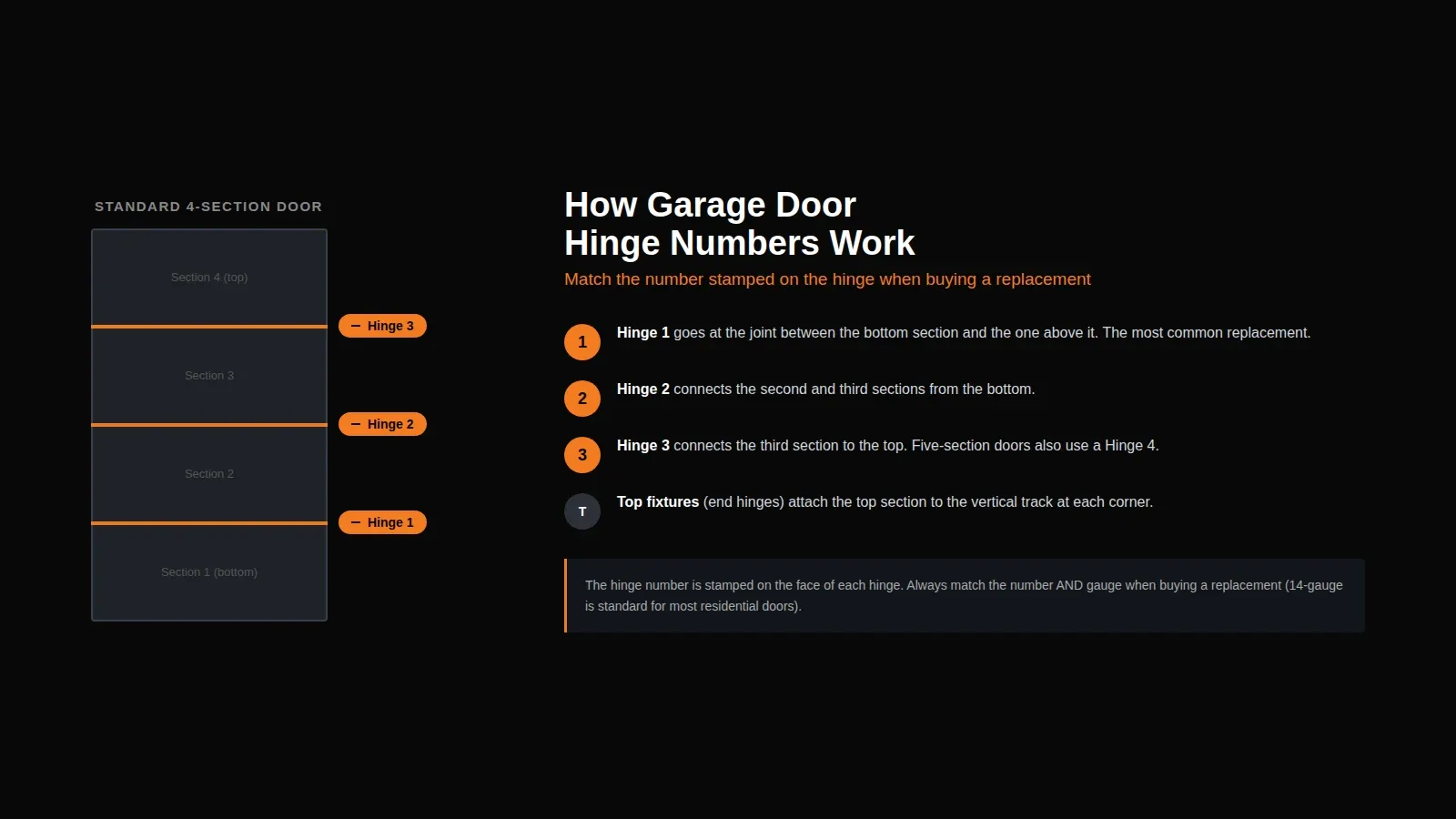
Swapping a number 1 hinge into a number 3 position is a problem because the geometry changes slightly as the door curves into the overhead track. The wrong-numbered hinge will sit at a slightly wrong angle, putting extra stress on the roller and the door skin. When you replace a hinge, match the number stamped on the existing one, and also match the gauge (14 gauge is standard; heavier commercial doors may use 11 or 12 gauge).
Five signs a hinge needs replacing
- Visible crack across the flat plate. A crack near a bolt hole means the metal has fatigued. A cracked hinge will eventually separate, letting the section drop onto the cable or bind in the track. Replace it before it fails completely.
- Oblong or elongated bolt holes. When the hinge moves under load, it slowly wears the holes from round to oval. An oblong hole means the hinge is no longer riding in a fixed position, which transfers extra stress to the screws and the door skin. You will often hear this as a rhythmic tick or knock on every cycle.
- Loose or seized roller pin. The roller spins on a pin that runs through the hinge bracket. If the pin is bent or seized, or if the roller wobbles more than a millimeter or two side to side, replace the hinge and roller together as a unit. Rollers are inexpensive, and swapping them at the same time saves a return visit.
- Rust or corrosion through the metal. Surface rust that wipes off is cosmetic. Rust that has eaten through the steel, particularly on the flat plate that bolts to the door panel, is structural. Minnesota winters are hard on hardware that sits in the freeze-thaw zone at the bottom of the door. Hinges showing pitting or flaking metal need to come off.
- Bent flag or bracket. If a vehicle has brushed the door, the bracket that attaches to the panel may be bent. A bent hinge throws the door off its plane and puts extra wear on the opposing side. It will not bend back reliably; replace it.
How many hinges does a typical garage door have
A single-car door (8 or 9 feet wide, four sections) typically has 10 hinges: two per joint at three joints, plus two top corner fixtures. A two-car door (16 feet wide, four sections) typically has 14 to 16 hinges, with more placed across the wider panels. When one hinge shows visible wear, it is worth inspecting the whole set while the technician is there. Hinges have the same number of cycles on them and often begin failing in sequence.
Replacing a hinge yourself vs. calling a technician
Replacing a single hinge at the first or second joint is a task many homeowners can handle safely. You need the door fully open so the springs are not under load, a socket set, and the correct replacement hinge. Remove the two or three bolts holding the hinge to the panel, slide the roller out of the track, swap the hinge, and slide the roller back in. Take the old hinge to the hardware store to match the number and gauge before you buy.
Stop before you reach the top two hinges, the top corner fixtures, or any hardware near the torsion spring shaft or the cable drums. The lift cables attach at the bottom corners and run up under spring tension. Working near those cable anchors or touching the spring system without the right tools and training can cause the door to drop suddenly or the spring to unwind. This is the same boundary that applies to all spring and cable work: if you are not certain where the tension is, have a technician handle it. For more on how springs and cables interact, see our cable repair service.
What a professional hinge replacement visit involves
When a Pronto technician replaces hinges, they will open the door fully to relieve spring load, then inspect every hinge and roller while the door is accessible. Worn hinges are replaced as a set rather than one by one, because a mix of old and new hardware wears unevenly. We check the rollers at the same time, since a nylon roller costs a few dollars and swapping it out takes seconds when the hinge is already off.
A hinge job on a standard single-car door generally takes 30 to 60 minutes. If the door has been running on worn hinges for a while, the technician may also need to check the tracks for alignment and inspect the cables for fraying, since those parts wear on a similar timeline. For a broader overview of what a full tune-up covers, see our safety inspection service.
What hinge replacement typically costs in the Twin Cities
| Job | Typical range |
|---|---|
| Single hinge (one or two, parts and labor) | $75 to $150 |
| Full hinge set, single-car door | $150 to $300 |
| Full hinge set, two-car door | $200 to $400 |
| Hinge plus rollers, full set, single-car door | $200 to $450 |
These are typical Twin Cities ranges for 2026, not Pronto prices. Actual quotes depend on the door size, gauge of replacement hardware, and what the technician finds when the door is opened up. Pronto provides upfront, flat-rate pricing before any work starts.
When worn hinges point to a bigger problem
Hinges wearing out in the first seven to ten years on a door can be a sign that something else is off. Doors that run against misaligned tracks, that have been hit by vehicles, or that were installed slightly out of plumb wear hardware faster than normal. A good hinge replacement visit includes a visual check of the whole door system. If there is something beyond the hinges worth addressing, we will tell you what it is and what it costs before doing any additional work.
If your door has been noisy or uneven for a while, it is worth having hinges checked as part of a general garage door repair visit. For comparison, rollers fail on a similar timeline; see our guide to garage door roller replacement to understand how the two problems can look alike. Pronto covers Minneapolis and the surrounding Twin Cities metro seven days a week. Call (612) 400-4180 or request a free quote to schedule a same-day visit.
Garage Door Hinge Replacement: Common Questions
How do I know which hinge number my garage door uses?
Count the joints from the bottom of the door. The hinge at the first joint from the bottom is a number 1; the next joint up takes a number 2, and so on. The number is also stamped on the face of the existing hinge near the roller bracket. If the stamp is worn off, counting from the bottom is the reliable method.
Should I replace all the hinges at once or just the broken one?
Replace the broken hinge right away to prevent a section drop. Then inspect the others: if the holes are starting to elongate or the pins are stiff, replacing the full set at once is usually more cost-efficient than making multiple visits over the next year or two. Hinges have the same number of cycles on them and tend to fail in sequence.
Can I use any brand of garage door hinge as a replacement?
Match the hinge number and the gauge first. Most major brands use the same geometry for a given number, but verify that the roller pin diameter and bracket width match your existing hardware before you buy. Cheap hinges rated for fewer cycles will wear faster than the door deserves.
How long do garage door hinges last?
On a typical residential door that cycles twice a day, standard residential hinges can last 10 to 15 years. Doors in cold climates that freeze and thaw repeatedly, or doors that have been hit by a vehicle, may show wear earlier. A tune-up visit that includes hardware inspection is the easiest way to catch worn hinges before they fail.
Is a grinding noise always a hinge problem?
Not always. Grinding can also come from worn rollers, dry tracks, a loose opener chain, or a misaligned track section. Worn hinges typically produce more of a bang or a metal-on-metal knock at a consistent point in the door's travel. See our guide to garage door roller replacement for how to tell them apart.
Worn Hinges? Pronto Can Help
Call (612) 400-4180 or request a free quote. Same-day service across the Twin Cities, 7 days a week.