Garage Door Maintenance Calendar for Minnesota Homes
Minnesota puts a garage door through four distinct stress seasons, and a single generic checklist misses the timing that matters. The short answer: lubricate and inspect in spring after the thaw, do a safety check in summer, replace the bottom seal and schedule a tune-up in fall before the freeze, and in winter focus on keeping ice off the threshold and listening for signs a spring is failing. What cold does to springs and rubber seals is different from what road salt and summer heat do. This calendar organizes the tasks by season.
Spring (late March to May): clearing the damage from winter
Spring is the first real opportunity to assess what a Minnesota winter did to the door. Start with the bottom seal. The rubber seal against the slab takes the most abuse from freeze-thaw cycles. If it is cracked or no longer making even contact with the floor, replace it before summer humidity widens the gap further.
Road salt and slush collect in the tracks during winter and leave a gritty residue that accelerates wear on rollers and hinges. Wipe the tracks clean with a rag, but do not lubricate the inside surface of the track itself, since grease there attracts grit and causes the door to bind. Lubricate the rollers, hinges, torsion spring, and opener rail with white lithium grease or silicone spray. Regular WD-40 acts as a solvent and strips the grease already there.
With the opener disconnected, check the torsion spring above the door. A visible gap in the coils means the spring has broken. Heavy rust or elongated coils are signs of a spring near the end of its life. If you see either, stop using the door and call a technician. Spring repair scheduled before the summer rush is easier to book and comes with an upfront estimate before any work starts.
Finish spring maintenance by testing the safety sensors. Winter grime collects on the photo-eye lenses. Wipe them with a dry cloth and confirm the indicator lights are steady, not blinking. Walk through the door while it is closing to confirm it reverses immediately.
Summer (June to August): the quiet season to stay ahead
Summer is the quietest season for garage door failures in Minnesota. The cold that stresses springs and freezes seals is gone, and the pre-winter rush has not started. Use it for the checks that are easy to skip when there is no crisis.
The most useful summer task is the balance test. With the opener disconnected, lift the door by hand to about halfway and let go. A balanced door stays in place. If it falls or floats upward, the spring tension is off and the opener is working harder than it should to compensate. Adjusting spring tension is not a DIY task. Our safety inspection and tune-up includes a balance check and spring tension assessment.
Check the weatherstripping on the sides and top of the door frame. Heat cracks rubber faster than cold, and a gap lets insects and humidity in. Also tighten any loose bolts on the hinges and track brackets. Vibration from daily use loosens hardware over a season, and a few minutes with a wrench catches that before it becomes a rattle or a wobble.
Fall (September to mid-November): the highest-value maintenance window
Fall is the most important maintenance window for a garage door in Minnesota. Every task done now is work you avoid in February when a spring fails at 7 in the morning and the garage is 10 degrees. The goal is to enter winter with fresh lubrication, an intact bottom seal, and a spring system that has been looked at by a technician.
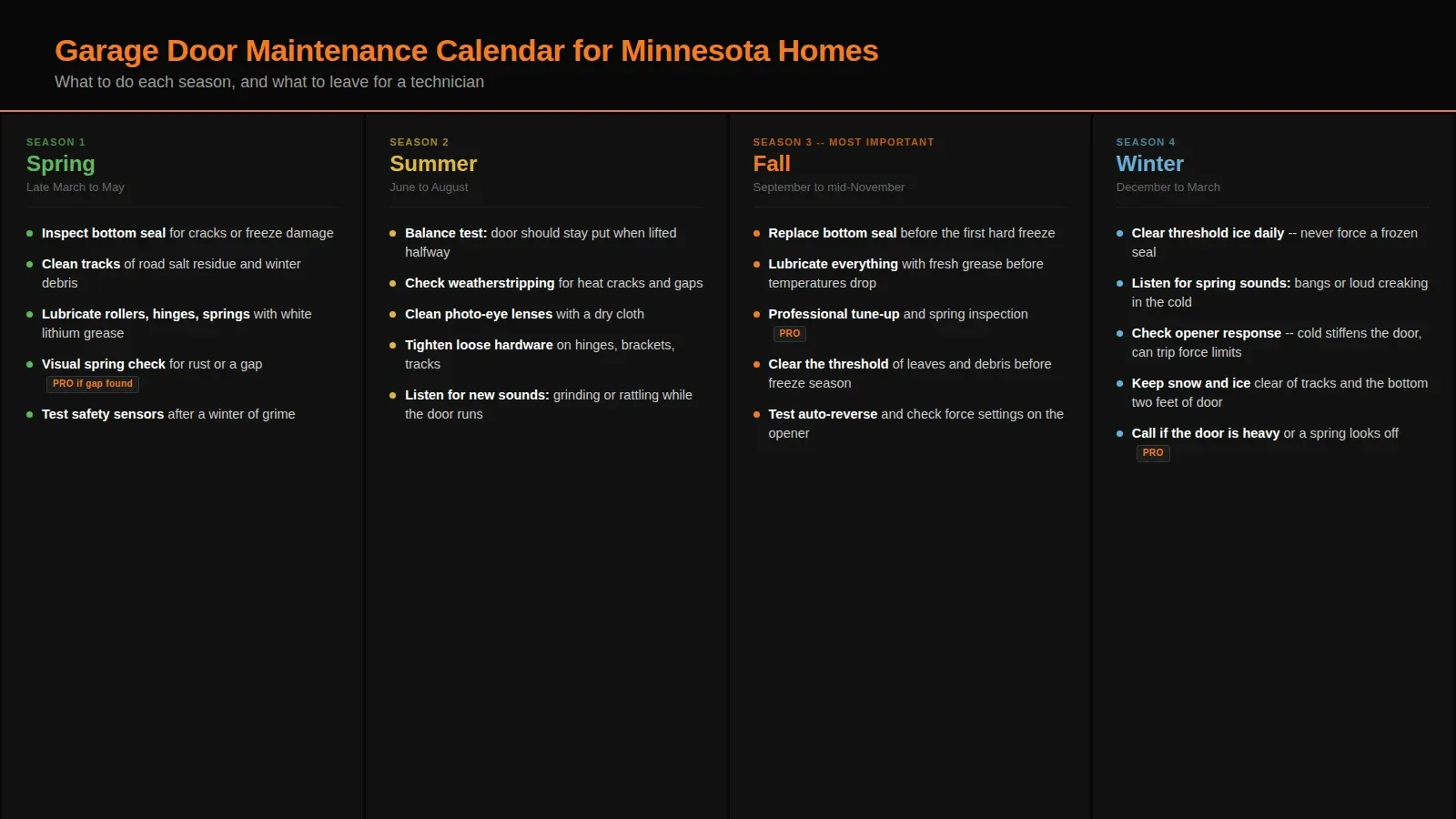
Start with the bottom seal. A cracked or stiff seal will freeze to the concrete slab on the first cold night, and pulling the opener against a frozen seal strips cables, bends bottom brackets, and burns out opener motors. Replace it if needed, then lubricate every moving part with fresh white lithium grease. Old grease thickens in cold and stops lubricating below about 20 degrees Fahrenheit, so refreshing it in October matters.
The most important fall task is a professional inspection of the torsion springs. Standard springs are rated for around 10,000 cycles, and a door used four times a day reaches that number in about seven years. Springs nearing the end of their cycle count fail more often in winter, when cold metal is less elastic and every stiff door puts more load on each cycle. A technician can tell you whether to replace now or whether a spring has another season in it.
Before you close out fall maintenance, clear the threshold area of leaves and debris that compact against the bottom seal. Once freeze-thaw cycles start, compacted debris holds moisture and accelerates the freeze problem you are trying to prevent.
Winter (December to March): managing problems in the cold
Winter maintenance is mostly about not making problems worse. The most common call in January and February is a door someone forced open after the bottom seal froze to the slab. When the seal freezes, break it free with a plastic scraper or a heat gun on low, not by pressing the opener button. Repeated force against a frozen seal bends the bottom bracket, frays the cable at the bottom fitting, and strips the opener gear.
Cold also affects the opener's force and speed settings. A door that is stiffer than usual in cold weather can exceed the opener's built-in force limit and reverse before it reaches the floor. If the door is stopping short or reversing for no visible reason, have the force settings checked before assuming the opener is failing.
Listen for new sounds during winter operation. A loud bang from the garage, especially in cold, usually means a torsion spring has broken. A broken spring leaves the door very heavy since the opener is now lifting the full weight. If the door suddenly feels much heavier when you lift it by hand, stop using it and call. For a broader checklist, see our post on winter garage door problems in Minnesota.
Year-round habits that catch problems early
Between seasonal checks, listen to the door every time you use it. A new scraping sound, a rattle, or a hesitation during travel are early signs of a roller going bad or a track that has shifted. Once a month, watch it travel from one end of its path to the other. It should move straight without tilting to one side. If you are in Minneapolis or the Twin Cities and something turns up during a seasonal check, Pronto offers free estimates with upfront pricing before any work starts.
Garage Door Maintenance: Common Questions
How often should I lubricate a garage door in Minnesota?
Twice a year is the right interval: once in spring after the freeze-thaw season ends, and again in fall before temperatures drop. Apply white lithium grease or silicone spray to rollers, hinges, the torsion spring, and the opener rail. Clean the inside of the tracks but do not grease them, since grease there attracts grit and causes binding.
Should I schedule a professional tune-up every year?
Once a year is a reasonable interval, and fall is the best time. A technician can check spring tension and estimate how much cycle life is left, which gives you the option to replace a spring before it fails on a cold morning. Our garage door tune-up post covers what the service includes and typical Twin Cities costs.
Why do garage door springs fail most often in winter?
Cold metal is less elastic, so a spring near the end of its rated cycle count is under more stress each time the door opens in cold weather. A spring that might survive until spring at room temperature often breaks in January or February instead. Pre-winter inspection catches those springs while replacement is still a scheduled, non-emergency job.
Can I do the door balance test myself?
Yes. With the opener disconnected by pulling the red emergency release cord, lift the door to about waist height and let go. A balanced door stays in place. If it falls or floats up, the spring tension is off. The test itself is safe to run. Adjusting the spring tension to correct the imbalance requires winding bars and should be done by a technician.
Ready for a Professional Tune-Up?
Call or text (612) 400-4180 for a free estimate. Pronto covers Minneapolis, St. Paul and the full Twin Cities metro seven days a week.