What a Garage Door Tune-Up Actually Includes
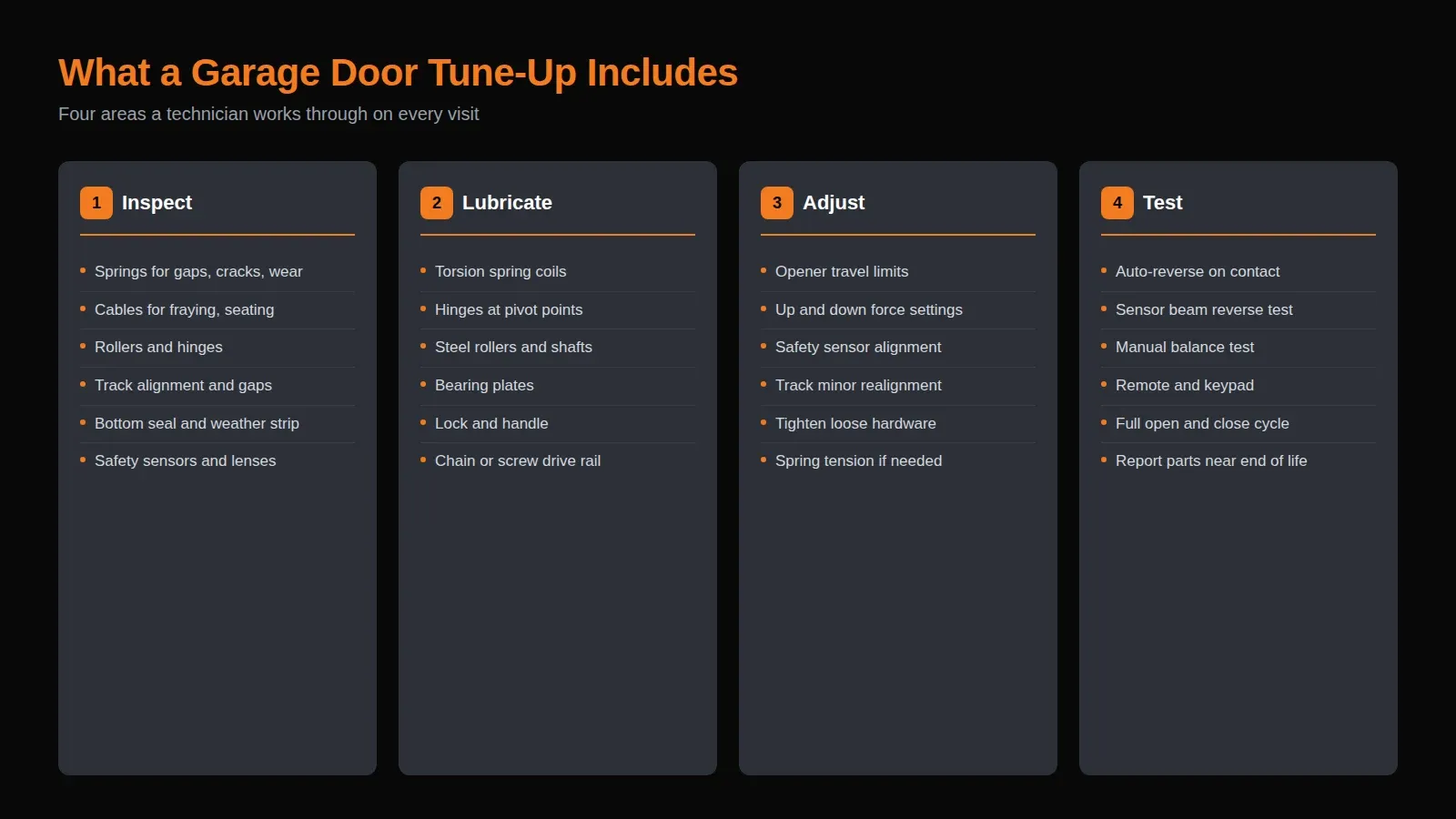
A garage door tune-up covers four categories of work: inspecting every moving part for signs of wear, lubricating the parts that need it, adjusting the opener and hardware to manufacturer specs, and testing the safety features. The whole job takes about an hour. It is the cheapest way to extend a door's working life and the most reliable way to catch a failing part before it turns into an emergency call.
The inspection: what a technician looks at
The inspection runs from the top of the door down to the floor. Each component tells a different story.
Springs
The technician checks torsion springs for a visible gap between coils, which means one has broken, and for rust, flat spots, or thinning at the ends, which means a spring is near the end of its service life. A standard torsion spring is rated for around 10,000 cycles. A household that opens the garage door twice a day will reach that in roughly 14 years, but a busier household goes through it faster. Finding a worn spring during a scheduled visit means a planned spring repair, not a weekend emergency call.
Cables
Lift cables run from the bottom bracket on each side of the door up to drums at the top. The most common failure point is the bottom few inches, where the cable wraps around the bracket and fraying starts. A cable can also look fine at the bracket but be off its drum, which causes the door to hang crooked or bind in the track.
Rollers, hinges, and hardware
Nylon rollers last a long time but eventually crack and the stem wears loose in the hinge socket. Steel rollers need lubricant, so dry or rusty rollers indicate missed maintenance. Hinges show age through elongated pivot holes: when the hole stretches oval, the hinge rocks instead of pivoting cleanly and the door begins to rattle. The technician also checks every bolt and bracket for tightness, since vibration loosens hardware over time.
Tracks
Track alignment problems show up as rollers riding hard against one side of the channel, a scraping sound at the same point on every cycle, or a door that hesitates mid-travel. The technician also looks for dents or bends, which often come from a car bumper contact that was never noticed.
Bottom seal and weather stripping
In Minnesota, the bottom seal matters more than it does in warmer climates. A cracked or compressed seal creates gaps that let cold air in, and it is also the part most likely to freeze to the concrete slab during a cold snap. When that happens and someone runs the opener anyway, cables fray and opener gears strip under the load.
What gets lubricated and what does not
Lubrication is more specific than most people expect. Not everything gets oiled.
- Torsion spring coils: a light coat of spray lubricant along the length of the spring reduces corrosion and the metal-on-metal wear that shortens spring life.
- Hinges: at each pivot point, not the flat face.
- Steel rollers: at the shaft and bearing. Nylon rollers do not need lubrication.
- Bearing plates: the round plates where the spring shaft passes through the wall bracket.
- Lock and handle: a small amount on the slide bar prevents rust-related binding.
- Chain or screw drive rail: yes, with the manufacturer-recommended lubricant. Belt drives are not lubricated.
One note on lubricant choice: WD-40 is a penetrant, not a lasting lubricant. It leaves parts dry and attracts grit. Use a silicone-based or lithium spray made for garage doors instead.
What gets adjusted
Two opener settings drift over time and need checking on every tune-up: travel limits and force settings.
Travel limits tell the opener exactly how far to open and how far to close. When the limit is off, the door stops short of fully open or keeps pushing down after it hits the floor, which strains both the opener and the bottom bracket. Force settings tell the opener how much resistance to push through before stopping or reversing. If the setting is too low, the door stops mid-cycle on cold mornings when the door moves stiffly. If it is too high, the safety reversal does not trigger when it should.
Track alignment corrections are part of the job when rollers ride against one edge of the track. The technician loosens the mounting bolts and taps the track back into position. Spring tension is also checked using the manual balance test. Adjusting torsion spring tension requires winding bars and proper training. Do not attempt it yourself: the stored energy in a torsion spring can cause serious injuries.
The safety tests
A tune-up that skips the safety tests is not complete. Three tests should be done on every visit.
- Contact reversal: a 2x4 laid flat on the floor in the door's path. When the door touches it, the opener must reverse within two seconds. If it keeps pressing, the force setting is too high or the reversal mechanism has failed.
- Photo-eye sensor test: with the door closing, passing a hand through the sensor beam should stop and reverse the door immediately. If it does not, the sensors are misaligned or the lenses are dirty.
- Manual balance test: with the opener disconnected and the door fully closed, lift by hand to waist height and let go. A balanced door holds in place. A door that drops has weak springs; a door that flies upward has springs wound too tight. Either result means the springs need attention.
What the technician reports to you
A good technician tells you what they found, not just what they fixed. Expect a summary of any parts showing wear: springs past mid-cycle, cracked nylon rollers, or a cable beginning to fray.
That summary is the main value of a tune-up. A spring caught during a routine visit means a planned repair. The same spring failing at 6 a.m. on a Monday is an emergency call at a higher rate. For current pricing, our garage door repair cost guide covers typical Twin Cities ranges for springs, cables, and openers.
When to schedule a tune-up in Minnesota
Early fall is the best window in the Twin Cities. Cold stiffens old grease, torsion springs near the end of their cycles are more likely to snap when they are cold and stiff, and a bottom seal that cracked over the summer will freeze to the concrete slab the first night temperatures drop into the single digits. A tune-up in September or October finds those problems while there is time to fix them without urgency.
Spring is the second-best time. After a hard Minnesota winter, tracks can be bent by ice buildup, seals are often compressed or cracked, and cables stressed by a partially frozen door may be frayed. An April or May inspection sets the door up for the high-use months ahead.
If your door has never had a tune-up and has been in service for five or more years, schedule one regardless of season. Pronto covers Minneapolis, St. Paul, and the surrounding suburbs seven days a week for both scheduled tune-ups and safety inspections and same-day repairs.
Garage Door Tune-Up: Common Questions
What does a garage door tune-up include?
A tune-up covers four areas: inspection of springs, cables, rollers, hinges, tracks, and seals; lubrication of the moving parts that need it; adjustment of opener travel limits, force settings, and track alignment; and safety testing for contact reversal, sensor function, and spring balance. The job typically takes about an hour.
How much does a garage door tune-up cost in the Twin Cities?
Typical tune-up prices in the Minneapolis and St. Paul area range from around $80 to $150, depending on what the service includes. If the technician finds parts that need replacement, those are quoted separately. Pronto provides upfront flat-rate pricing before any work starts, with free estimates and no obligation.
Are garage door tune-ups worth it?
Yes, particularly for a door that is more than three to five years old. A tune-up catches worn springs, fraying cables, and loose hardware before they fail. In Minnesota, the fall timing matters: a door serviced before winter is far less likely to strand you when temperatures drop. The cost of a tune-up is typically a fraction of what an emergency repair call runs.
How often should I get a garage door tune-up in Minnesota?
Once a year is the standard recommendation for most homes. If the garage sees heavy use, twice a year makes sense. Early fall is the highest-value time because it prepares the door for the demands of a Minnesota winter. A spring inspection after the freeze-thaw season is a good second visit.
Can I do a garage door tune-up myself?
Some steps are safe to do yourself: clean the tracks, test the contact reversal with a 2x4, check the photo-eye sensors, and lubricate with the right product. Stop at anything involving spring tension or cable adjustment. Both are under significant stored energy, and adjusting them without the proper tools and training is dangerous.
Schedule a Garage Door Tune-Up
Call (612) 400-4180 or request a free quote. Same-day service across the Twin Cities, 7 days a week.